Thursday, March 23, 2017

Denimosity

Like most people, I have owned countless pairs of jeans. I've lived in them for the larger part of my life since around 1971. For the most part, I've been satisfied with my purchases, but occasionally, a recalcitrant pair will surface, challenging all that I know and believe. Witness one such story.

Shortly before Christmas, I visited my local Macy's to buy several pairs of pants. I didn't go there with the intention of buying blue jeans, but after selecting a pair of camel colored duck Levi's and a slate gray pair of Calvins, I thought it might be a good idea to pick up a pair of dark washed Levi's 514's (number three from the top on the picture from my closet at right). I'd bought this style before, and people always said they looked good and fit well, so I banked on that. After all, I was working for Macy's at the time, and people loved to comment on each other's clothes. My female friends would not shy away from giving you an honest and truthful opinion, one way or the other, and I appreciated that. It saved me from a few potential fashion disasters such as the one that occurred around 2004, when my friend Jenny told me that she'd better never catch me wearing another pair of pants with a visible elastic waistband.

But back to the Macy's jeans. Before my purchase, I tried them on in the fitting room, checking them out from every angle, since you cannot be too careful there. The first day I wore the jeans to work (we had a casual dress policy), I noticed that as the day wore on, the jeans loosened considerably. By the end of the day, it became a struggle to keep them pulled up at the waist. They pooled over the tops of my shoes like rococo drapes in the parlor of a Louisiana plantation house. I brought them home and washed them, and the next time I wore them, they lasted a bit longer, maybe until early afternoon. This pattern continued throughout January, when I left Macy's to take semi-retirement.

Once I was not working, I had the opportunity to exercise more often, and I lost a few pounds. I saw this as a very positive thing until the next time I tried to wear the jeans. I put them on before I left the house one morning, and by lunchtime, they were sagging mercilessly. Now, I'm not a total fashion slave (okay, maybe sometimes), but this was unacceptable. It was time for action.

I bundled up the jeans in a Macy's plastic bag and headed to North Point Mall, where I had purchased them. I did this thinking that maybe the store would replace them. I wasn't looking for a refund, because I had owned them (and worn them) a few times, but I just wanted another pair like these. When I walked into the men's department that weekday morning, it was almost deserted, and within a minute or so, a male sales associate walked up to me and asked if he could help.

I was very honest with the sales person. I told him that I had purchased the jeans, had worn them on a few occasions, but that they just weren't working for me, and that I would like to exchange them. Mind you, there was basically no wear on these pants, but they seemed awfully big for the size on the label. The man looked concerned and downtrodden, and he began to ask questions. Eventually, I just said, "Hey, I used to work for the company. Tell me, is this something you cannot do?" At which point, he replied that no, since the jeans had been washed, they could not be returned. Now, I know that people do this all the time, but I didn't push the point. I put the jeans back in the bag and politely headed home.

That evening, I did a geeky thing: I looked up how to shrink jeans on the Internet. There's even a WikiHow page on how to do it. The next day, I followed the online instructions and voila, I had an almost perfectly fitting pair of jeans, except that they were still too long. After a trip to our favorite tailor shop and $16 for alterations, they were perfect. But seriously, I told myself, all this for one pair of pants. I wasn't even wearing them to a prom or anything. I had purchased them on sale, but after the alternations, any financial benefit from that had been negated.

I can only hope that all this effort is worth it, and that this pair of high maintenance jeans, like others in the past, will have a story to tell when they are retired to Goodwill or some other needy charity. But somehow, I think they'll always be treated just a bit differently from the other pairs in my closet.

I guess the moral of the story is that sometimes, you just have to work at something to get it right, or alternatively, anything worth having is worth fighting for. Seriously, there is nothing more awful than an ill-fitting pair of pants.
Monday, March 20, 2017

Gratis

Just the other day, I was playing the game Hanging with Friends on my phone, and as it happened, my best word to offer up to my challenger at the time was "gratis." That's a word you don't hear every day. Growing up, my dad used it all the time, and I wasn't sure what it meant, so one day, I asked him. His definition was simple: "free."

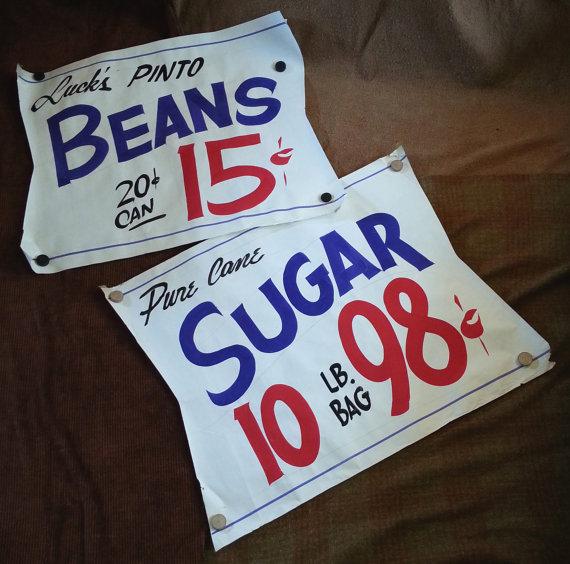
We didn't pay for lots of stuff in those days. As you may have read elsewhere on this blog, my dad managed a grocery store, and in that position, one benefited from many gratis deals. Food brokers gave away free promotional materials to merchants if they sold a certain level of goods or maintained a particular level of stock for an item, and my father was rather gifted in the art of grocery marketing. He would mark cans of peas that had been selling for 29 cents at three for a dollar, and they would fly off the shelves. Things like that always amazed me.

One way Dad increased sales was with his outstanding hand-lettered promotional signage. Many Sunday evenings, he would make signs at the dining room table. I admired the sleek way he drew 9's, like an elongated oval that fell back on itself. Sometimes I helped make them, and even though mine didn't look nearly as symmetrical or colorful as his, he displayed them nevertheless. Sign making was an art of sorts, and his were very eye catching. So sales were good, and we got free stuff.

Thinking back on the dizzying array of gratis items we received, I realize that we had all bases covered. Here are a few samples of gifts that were bestowed upon our family during the 1960's:
  • Cutlery - This seemed to be a very popular item. We had knife sets "of the highest quality" from faraway places like Japan. (Come to think of it, we had lots of things from Japan.)
  • Flatware sets - We received a few of these, the most notable being a 24K gold electroplated set that was stored in a rolled-up moss green plastic sleeve. This set was reserved for fancy dinners like Easter or the times when someone would bring a new boyfriend or husband over for dinner.
  • The Teem Rabbit - This was an incredible chartreuse and yellow stuffed beast, standing over five feet tall, which my Dad brought home to me one Easter. (Teem was a 1960 Pepsi product, the equivalent of the recently-introduced Sprite from Coca-Cola.) Years later, the rabbit deteriorated somewhat after we had stored it in the attic and birds had nested in its stomach. But that wasn't enough to keep our inventive, packrat neighbor Kyle Davis from asking for it, to which we generously obliged. What he did with it, I have no idea.
  • Dented cans - We received many dented cans of food, many of which were unlabeled. My dad would write the contents in grease pencil on the sides of the cans. My mom could not stand this, because a) she felt that she had no clear idea of what was really in the cans, and b) she did not want us to get botulism from breached can contamination. I shared her concerns.
  • LP's - Occasionally, we would receive gratis records. The one that stands out in my mind is a two-album set of the Chase and Sanborn 102nd Anniversary Edition radio program featuring Edgar Bergen and Charlie McCarthy, which I later found online as an MP3 (you can find anything out there). I still have those LP's.
  • Gum machine toys - It is inevitable in the operation of an urban grocery store that candy machines will be violated and will break, spilling their contents on the floor. The vendors would come and replace all the gum and toys, and in those rare cases, my dad generally scooped up some of the escaped toys and brought them home. I had several boxes of these and played with them ad infinitum.
None of this was very expensive, but oddly enough, I have kept many of the items. My mom had stored the cutlery and flatware at her house, and when she passed away several years ago, we packed them up and brought them home. Our girls are now acquiring the cutlery piece by piece as they set up their respective households.

I know I'll be fine with eventually disposing of all the gratis items except for one, and that's the moss green sleeved 24K gold flatware set. When I see that, I remember how we used it when Aunt Ida brought her boyfriend Mack and later, her new husband Herbert over for dinner. Come to think of it, just like that flatware, Herbert was a keeper.

Monday, November 21, 2016

You're in Good Hands

It would be an understatement to say that 2016 has been, to use one of Jimmy Buffett's favorite words, tumultuous. We survived a sideshow of an election. Britain voted to exit the European Union. Hurricane Matthew and earthquakes in central Italy and New Zealand left destruction in their wakes. We lost David Bowie, Glenn Frey and Leon Russell. Bob Dylan evaded the Nobel Committee to such an extent that we wondered for a while if he was still around. I think we all agree that now, we just want to enjoy the holidays and move on into 2017. Somehow, in light of all this, I remain optimistic. Why? Because I see promise in our next generation, promise which is already being fulfilled in a variety of ways. We're not waiting for it to happen...it is already happening.

There was no book that told me how I was supposed to feel at this stage of my life, but one learns by doing, as they say. Despite what we might hear or read about the millennial generation (I'm sure they're exhausted by now from hearing that moniker), what I see now are millions of young people committed to making it work. Think about it for a minute: when we baby boomers graduated from high school, there was plenty of work to do. Regardless of whether you launched into a trade or marched ahead to college (and sometimes more college), you were fairly certain that jobs would be plentiful. There were prescribed destinations, formulas for success.

But today's world is a different animal. A college degree is practically a necessity these days, and obtaining one does not, of course, guarantee that jobs will be available in one's chosen field. Getting a step up to the first rung of the ladder seems much more difficult than it used to be. So what does today's generation do? If they're lucky, they land lucrative jobs. If not, or if things don't pan out where they've landed, they keep moving. They explore uncharted career territory, they make the field broader, and in some cases, they even knock down the walls that contain that field. They open restaurants and shops, save our lives in emergency rooms, serve in the military, and build successful businesses, à la Facebook. Many of them are now teaching the next generation after theirs.

Does this sound familiar? Absolutely. We've all been there or are in the process of getting there. And for my money, there are some great things on the horizon. Sure, I have a vested interest, because I have two grown daughters and a son-in-law who are part of this generation. I applaud them, as well as each and every young person across this world who is working to move ahead these days. I think we'll look up in a few years and say wow, these guys knew what they were doing.

Bring on 2017.

Saturday, July 16, 2016

Talking to Myself

This is the third and final installment in a series about my years living in the city of Chicago.

We didn't know it at the time, but legendary author Studs Terkel lived in our immediate neighborhood in Chicago, a couple of blocks south of our apartment on West Castlewood Terrace. One of Studs' bestsellers was his autobiographical "Talking to Myself," and today's post borrows from that title.

In my previous post, "Steps to Lake," I described the adventure of finding our city apartment. Once we had settled into the neighborhood, we began to appreciate its cadence. We observed a regular cast of people coming and going every day, which may seem unusual in a metropolis the size of Chicago, but the city is, after all, a patchwork quilt of smaller neighborhoods. People tend to go to the same stores and restaurants, and they typically take the same buses and trains to and from work.

Fairly soon after arriving in the city, we noticed that a significant number of said people seemed to carry on conversations with themselves. Now, I realize that this is something almost all of us do from time to time, but in Chicago, we saw it elevated to an art form. We began to think absolutely nothing of people talking to themselves on public transportation or while walking down the street. You might not see it at a Chicago Symphony concert, but darned tootin' you were going to see it on the El trains.

Most of the time, when people talked to themselves, they didn't appear to be waiting for responses; rather, they would engage in diatribes about this or the other thing, which was often something quite mundane. I wondered if they were trying to burn neural pathways to memorize events or just create imaginary companions for themselves, because it is true that we observed a lot of loneliness in the city. But overall, these people didn't appear to be in the least concerned or upset about their topics of conversation (as it were) or the fact that others were trying to avoid staring in their direction, and I had to hand it to them for that. But one morning, we observed a self-directed conversation which was like no other.

The temperature that morning was between zero and ten degrees (not unusual for a winter day in Chicago), and we were waiting for the bus which ran north up Sheridan Road to connect with an El train at Howard Street. The bus was taking forever, so we ducked into the McDonald's at the corner of Foster Avenue and Sheridan for some breakfast. There, along a wall of windows, sat a late middle-aged woman facing the wall and carrying on a conversation with an imaginary friend. She was quite animated, talking and gesturing with her hands all the while. We ordered our breakfast and then took a seat to silently observe.

This was back in the day when people could smoke anywhere, and presently, a young man walked up to the lady and asked her for a light for his cigarette. She turned to him and answered, "Why, yes." She then looked back at the wall, pulled out her lighter, and said to her imaginary companion, "Excuse me." When she had finished lighting the young man's cigarette, she turned back to the wall and, without missing a beat, resumed her conversation: "Now, as I was saying...".

This tiny episode confirmed to me that I was indeed living in a place of wonder and amusement. There would be many other such stories throughout our time in the city, but I found that one memorable for the woman's spontaneity and impartial sense of common courtesy. In fact, the whole thing gave me pause for thought and also affirmed to me that it was all right if I occasionally talked to myself, which has since come in handy on many occasions.

I recently read an article that claimed scientists now believe that talking to ourselves actually might be a sign of genius. Supposedly, it helps by stimulating memory, keeping us mentally focused, and clarifying our thoughts in order to firm up decision making. If this is true, I encountered untold numbers of geniuses in Chicago without even knowing it. I wish I'd gotten some autographs.

Truly, living in the city was a learning experience. I could go on and on with these stories, but it's almost time for dinner, and I still have to call my friend. Speaking of, I wonder why he never says anything.

Saturday, June 25, 2016

Steps to Lake

This is the second installment in a series about my years living in the city of Chicago.

Looking for an apartment in a big city is an adventure, especially when you're young, with limited resources. You soon abandon the idea of landing a place built within the last few years and hope that you can at least find something built since the advent of electricity. Depending on supply and demand, the pickings can be slim, but sometimes, the sales pitch alone is worth a visit.

The Four Towers apartment building (now known as
Shoreline Condominiums), our first city home
When my wife Karen and I got married, we knew we wanted to move to Chicago. This was a calculated decision based on the idea that since Karen was from Boston and I was from Memphis, moving to either of those places would have provided one or the other of us a certain "hometown advantage." Not that this would have been a problem, but we really wanted to launch our lives in our own place, and since we had many friends from college who still lived in the Chicago area, or "Chicagoland," as it is sometimes called by the locals, we made the decision to move to the city. We had both attended Northwestern, which is located in the leafy North Shore suburb of Evanston, but being in our early twenties, we longed to be more in the heart of things. And so, on one weekend in the spring, we began looking for an affordable apartment down in the city, south of the Evanston-Chicago border.

Even though Evanston is officially termed a suburb, it does not look at all like one. The three and four story residential buildings and storefront businesses flow seamlessly as you head south along Lake Michigan into the north side of Chicago at Howard Street, where a large elevated train or "El" station marks the dividing line. Immediately south of Howard sits the venerable Rogers Park neighborhood, which for many years was home to kosher delis and lots of mom and pop businesses. In those days, Rogers Park was a relatively quiet, established neighborhood, and we looked at a few places there, but ultimately, we ended up heading a bit farther south, to the Edgewater neighborhood, which was part of Uptown. There were many Edgewater apartment buildings in our price range, which at the time was less than $250 a month. These days, that would be unattainable, but in 1978, you could actually find a number of apartments renting in that range. We scoured the newspaper listings and came up with several attractive options.

One of the first places we visited sat directly on Sheridan Road, a major north-south thoroughfare paralleling the lake shore several blocks to the east. This apartment was memorable for its liberal use of red velvet flocked wallpaper. I'm sure there were other wall colors represented in the unit, but after seeing the red, nothing else mattered. Given that, and the fact that the apartment sat above a busy street and had absolutely no character, we opted to continue looking.

Another apartment caught our attention with its tagline, which read, "Steps to Lake." We stopped by and found that indeed, the place was only a short walk from Lincoln Park and Lake Michigan, but that was really its only redeeming value. The front door opened into a lobby which was probably stylish in the 1940's but was seriously showing its age. Many buildings in Chicago open onto a center courtyard, and the leasing agent told us that this one did as well. We poked around looking for said courtyard and finally found what he was referring to: an open-air architectural aberration in the rear of the building which effectively provided a chute from the top floors to the bottom, where discarded cans of paint lay abandoned and rusting.

The agent took us to the apartment, and it was a sight to behold. The walls contained built-in cabinets with drawers which did not slide in and out as intended, but rather sat in the cabinets at angles. The windows looked out on other buildings, and the floors needed refinishing. The place just looked tired. At one point, the agent pointed out a small alcove and said, "This would make a nice sewing room for the ladies." But sewing room notwithstanding, we just weren't interested. We said thanks to the agent and continued looking.

Funny thing, but the perfect apartment turned out to be just around the corner. When we finally stopped in to look at it, we realized it was exactly what we had hoped to find. It was a little one bedroom unit with a Pullman kitchen built into a side wall of the living room, and it had a quiet, comfortable bedroom with a functional little bathroom that must have had about ten colors of tile on the wall. But it was clean and it was livable, not to mention that it was on the eleventh floor of a building called Four Towers, on North Marine Drive, and it sat directly across the street from Lincoln Park. We signed the lease.

We settled into city life quickly. We learned how to walk groceries home from the supermarket, how to entertain on a shoestring, and how to find our way around using only public transportation. In the evenings after work, or on the weekends, we would take our ten speed bikes down the freight elevator and ride them across the street into Lincoln Park and onto trails which led directly over to the lake shore. From our living room windows, we looked out over the north side of Chicago, and at night, we would turn off the lights and let the city illuminate the room. Many evenings, we would sip glasses of Valpolicella wine with friends and just gaze out at the seemingly endless metropolis.

And so, in the end, we had a place to call home, a place without red velvet flocked wallpaper, and with drawers that actually slid in and out of the cabinets. It was clean, quiet, comfortable and, for being on a tight budget, actually rather stylish. We felt like we had arrived, and all for $185 a month (plus electricity). But perhaps best of all, we were still literally only "Steps to Lake."