Showing posts with label Family. Show all posts

Thursday, March 20, 2025

Estelle

Estelle Magee, my grandmother on my father's side, was the ad hoc historian of our family.  She had absolutely no equal in that regard.

Grandma was married at the age of fourteen, and I don't recall if she ever had the time to finish high school, but it didn't really matter, because Grandma had the unique ability to remember events in vivid detail, no matter how far in the past they may have been.  As she often told me, "I always made A's in history".  No kidding, Grandma.

During the 1960's, Estelle's husband Leslie, my paternal grandfather, was the victim of a series of strokes which left him progressively more incapacitated.  His first stroke occurred while he was working at his country store on Highway 64, just a few miles outside Memphis.  In an instant, Grandaddy went from a sharp, numbers-savvy grocer with a quick wit to a person who required almost constant care.  Grandma had no choice but to fill in the gaps as best as possible -- there was, of course, no way that they could keep the store, so Grandma and Grandaddy moved into the city, fairly close to our Highland Heights neighborhood.  They had a nice little house on Biltmore Street, just off Macon Avenue.

For a while, Estelle had no trouble taking care of Leslie.  I remember being at their house that momentous night in February, 1964, that The Beatles first appeared on The Ed Sullivan Show.  Grandaddy didn't want to watch "those mopheads", but I convinced him not to change the channel, and I think I even saw the faintest gleam in his eye once "I Want to Hold Your Hand" kicked in.  But, of course, he would never admit it.

Then in 1966, Grandaddy suffered a second, more severe stroke one afternoon after Sunday dinner at my Aunt Mary's house. (Mary was Estelle's younger sister.)  We waited tenuously in Aunt Mary's front guest bedroom for an ambulance to arrive, and from that day forward, things were never the same for Estelle and Leslie. 

Leslie had to be confined to a Veteran's hospital for a couple of years, and Estelle went to the hospital every day to stay with him.  My Aunt Alma, Leslie's sister and a retired nurse who was already in her late sixties, would often go over to make sure that Leslie was being cared for to her satisfaction.  But always, Estelle was there.

After a time, Grandma moved out of the house on Biltmore to a smaller house on Hollywood Street in north Memphis, and Leslie was able to return home.  But by this time, he was totally confined to a wheelchair, and his days were spent in one long string of Pall Mall cigarettes and 6-1/2 ounce Coca-Colas, which he drank by the case.  Since my dad was a grocer, he arranged for the Coke man to deliver cases to Grandaddy at a good price.  Over time, Grandaddy's condition deteriorated to the point where he could no longer be cared for at home, and he passed away in 1969, after a final protracted stay in Veterans' Hospital.

During the period when Estelle made daily visits to the hospital, my mom and dad would take me to stay with her while they went out for dinner and a movie, or in some cases, for a weekend.  During these visits, Grandma would treat me to Southern storytelling the likes of which I had never witnessed.  She could relate stories about people who had lived during the Civil War, about former Presidents long departed from this earth, and the more colorful family members.  She seemed to know a little bit about almost everything and was full of the most wonderful anecdotes I had ever heard.  I came to realize that in this lady existed a vast repository of family history which no other single person could even begin to match.

Grandma had a stock set of phrases which she would often call upon in certain situations, and one of my favorites was "Little Baby Jesus wouldn't like that."  This was reserved for those times when I had acted out of turn.  Grandma could never get too mad at me, but she tried.  On one occasion when I was about three or four years old, my parents decided to leave me with Grandma while they went out of town for a weekend trip.  Miffed in a childlike way that I was being left alone, I incited a heated exchange between us:

"Grandma, I don't like you!"

"Now, Ricky...little Baby Jesus wouldn't like that."

"Well...I don't like him either!"

In her life, Estelle went from being a traditional Southern woman with fairly conservative views to a more progressive citizen of the New West.  Shortly before Leslie's death in 1969, my Uncle Richard moved Grandma out to Camarillo, California to live with him, his wife Ruth, and their wonderful collection of family dogs, not to mention the 800+ pigeons that my uncle kept.  During one of our last visits together, I sat out by the open fire pit on a crisp California evening playing some of Grandma's favorite songs on the guitar and singing to her.  She told me that night that she could never really move back home to Tennessee, that California was her new home, and that she felt very lucky to have a family there who would take time to care for her and make her a part of their daily lives.  But I think it was one of those situations where she simply got back the love and care that she had provided Leslie in his final years.

Every time I try to recount something in history, whether it is national, international or just familial in scale, I think about Grandma.  She passed away in 1985, but she left behind some wonderful, colorful memories and more than a few great stories.

Friday, March 15, 2024

The Chocolate Set

My mom and her husband had finally decided to sell their farmhouse just outside Jackson, Tennessee. Set way back from the road, it had always been a favorite destination of ours, one where we'd shared many warm and wonderful family times. But in recent years, my folks had been spending most of their time in Pigeon Forge and Gatlinburg, way over in East Tennessee, so they felt it was time get what they could for the farm property and move on. In 2004, they decided to host an estate sale at the farmhouse, and my Aunt Ida Mae, who lived about 30 miles away in Trenton, offered to help them get everything ready.

Going through a house where you've lived for some fifty-odd years always presents challenges in the sheer volume of articles to be sifted through, and this was certainly no exception. It was decided that the staging area for the sale would be the large dining room, which when I visited was chock-full of dishes, silverware, utensils, and a smattering of memorabilia. Fortunately, neither my mom nor her husband was big into collecting, but even so, the accumulated assortment of household goods was somewhat remarkable, and the dining room table was overflowing.

The sale went off without a hitch and seemingly, to everyone's satisfaction. A few items of special significance had been put away and were not part of the sale, but by the time the event was over, the happy couple was able to list the property and head east to start their next chapter of home ownership. From a distance, it appeared to me that the sale had progressed well. Little did I know that trouble was brewing.

My mom Peggy and her sister Ida (whom all those of her age called Ida Mae) were close. Although twelve years apart in age, they were best friends. When Ida would come to Memphis to visit, she and my mom would routinely stay up until past 2:00 in the morning, drinking coffee and catching up with each other's lives. Although different in temperament, my mom being the subtle one and my aunt the outspoken steel magnolia, they shared enough in common that they were, in modern parlance, "besties." Whenever Ida was around, laughter inevitably ensued. So, it came as a surprise when only a few weeks after the sale had been completed, my mom mentioned to me on the phone one day that she and Ida had encountered "a little problem" and weren't speaking, which to my knowledge had never happened.

It appeared that during the sifting through of the household goods in preparation for the sale, my mom had found a porcelain "chocolate set," similar to the one pictured here, consisting of a pitcher and four matching cups. It was of the design that was so popular throughout the early part of the 20th century, flowers and ribbons, that sort of thing, but that was my mom's style. According to her, when she found the set, she mentioned to Ida that she hadn't seen it for years and was so happy that their mother had left it to her. (My grandmother had passed away 38 years earlier.) Suddenly, Ida stopped what she was doing and said, "No, Peggy, Mother left it to me. Remember?" My mom certainly did not remember, and that's where the trouble began.

The next time I talked to my mother, after we had exchanged our routine updates about what was happening in Atlanta and in Pigeon Forge, I asked how Ida was doing, assuming that the rift had passed. "Well, I haven't heard from her," was my mom's reply. I thought this somewhat odd, given their lifelong closeness, but I let it pass and moved on to other topics. But as the weeks, then months, of 2005 went by, my mom's answer when asked about Ida remained the same, that no words had been exchanged between them. I became concerned about this, because my mom and aunt had always relied on each other to be there. Treading lightly, I finally asked my mom if she had tried to reach out to Ida. The answer was, "Well, no." A-ha. Digging deep into an academic background in psychology and human behavior that I had never used professionally, I suggested that she might make the first move.

Sometime in the very early days of 2006, the dam finally broke. My mom mentioned to me rather casually that yes, she and Ida were back on speaking terms. I didn't ask for details but expressed my happiness that the situation had been resolved. However, the elation turned out to be short-lived, because Ida took her last breath in January of 2007. By this time, my mom had begun to suffer from a debilitating respiratory condition and was unable to attend Ida's funeral. I was quite concerned, because I knew that only if she were in very poor condition would my mom not have been there for her sister. And it turned out that my concern was warranted, for my mom passed away fifteen months later, in April of 2008. It occurred to me that in their last few years together, and I would go so far as to call that time precious, a dispute about an inanimate object had come between them.

A few weeks after my mom had passed, we started going through her possessions, trying to decide which to keep and which to give away. Our two daughters had fond regard for some of the items, but when it came to the chocolate set, they both treated it as if it were made of plutonium. Finally, Sarah said that she'd like to have the pitcher and glasses set with etched sailboat designs, and Hannah agreed to inherit the chocolate set. (But it still doesn't live with her, so there's that.)

Of course, there's a lesson in all this that we shouldn't get too wrapped up in trivial disagreements, because we never know what's right around the corner. At this point, I can only hope that somewhere up on high, my mom and Ida are together sipping coffee, not hot chocolate...out of paper cups.

Wednesday, May 4, 2022

Breaking the Sour Cream Barrier

I am that rare individual who possesses a California birth certificate and yet does not care much for avocados. I'm often asked, and these are the exact words, "How can you be from California and not like avocados?" Well, I only lived there full-time when I was a wee tot, and back in those days, Angie Dickinson had not made those 1970s commercials that resulted in the avocado becoming an object of culinary desire. In later years, when I would spend summers in the San Fernando Valley and Ventura County, I was more enamored of Thrifty ice cream and whatever nibbles I could pick up around town while riding my Spyder bike. Food was an afterthought -- sunshine was first on my mind.

Over the years, there have been certain foods which have just never had much appeal to me. In some cases, I downright fear a food, but that's getting better as I get older. And it's about time, since in many senses of the word, I guess I am a senior citizen. My latest personal victory has been sour cream. I've wondered for years why people like to dabble this appropriately-named concoction onto otherwise delightful Mexican food, but it took a to-go order mistake for me to acquire a taste for it.

One day during the height of the pandemic, I placed an online to-go order at my local Chipotle, during a brief interval in which it was not shut down because of lettuce or salsa contamination. I ordered my usual: a bowl with black beans and cilantro-lime rice, with barbacoa for the protein, and corn salsa, grated cheese, and salsa verde. When I picked up the order, I didn't check the contents, and I arrived home with a chicken bowl, pinto beans and white rice, pico de gallo, and a topping of SOUR CREAM. In a bout of both horror and hunger, hunger won out, and I started eating, realizing that I actually liked this, so much so that on my next online order, I intentionally ordered what I had been served in error. And that was the beginning of my sour cream fascination.

Now, a year or so later, I cannot order the #1 combo at Taco Bell (three crispy Supreme beef tacos with a beverage of your choice) without sour cream. In fact, I've started saving the little bits of taco that crack off as you're eating and using them to scoop up more sour cream. In so doing, I tell myself that I am actually eating a taco salad, which is kind of healthy, I think.

This experience with crème fraîche makes me wonder what else I may be missing. I recall vividly sitting in front of an order of KFC mashed potatoes one night in the 1960s and being told by my mother (an otherwise gentle and caring individual) that I could not leave the table until they were finished. I sat there for an hour, probably missing much quality television, until I finally dipped my spoon into the potatoes and gravy, put it in my mouth, and experienced what can only be described as a religious awakening. Since that evening, I have been a huge fan of mashed potatoes, and also now enjoy many other foods that I once feared, among them broccoli, asparagus, cauliflower, carrots, and even tater tots. I try not to even think about all the years without tater tots.

One day last summer, I was having lunch with my daughter Hannah at Mi Vida on the waterfront in Washington, D.C. It is referred to online as "Celebrity chef's high-end Mexican fare in a glamorous bi-level setting with killer waterfront views." Without my even thinking about it or paying much attention, Hannah ordered guacamole. When it arrived, I took a bite and found that I actually enjoyed it. This meant that in a sense, I had achieved something major, since guacamole contains more than a little avocado. Hannah was elated and immediately snapped my picture while I sat there smiling and eating the guac. She then forwarded it to our whole family, including our daughter Sarah, whose homemade guacamole I had often refused. I was reprimanded by Sarah, who said something like, "Oh, sure, you won't eat mine, but you'll eat it there. Fine."

I really do try to keep an open mind about things, but I know that food remains a weak point. My kids tell me I eat like a teenager, but I don't think that's necessarily true. For example, I tend to favor those things that McDonald's has on sale in the mobile application, not just any random old thing on their menu. And I almost always, practically never, ok, maybe once in 2019, order large fries.

Wait a second. Can you put sour cream on top of guacamole?

Wednesday, April 13, 2022

Presentation Skills

When I worked for Macy's Technology, I had something of a reputation for preparing and leading meetings. I stretched PowerPoint to its limits and always tried to make presentations aesthetically pleasing or, in some cases, humorous. My feeling was that if you were going to have to sit through an hour (or more) long meeting, it might as well be entertaining. There is absolutely nothing more boring that sitting through a series of slides (as we used to call them), each of which is chocked full to the brim with unnecessary details that are of interest to only a limited audience. Plus, if you wear glasses, you'll probably have a hard time reading everything anyway.

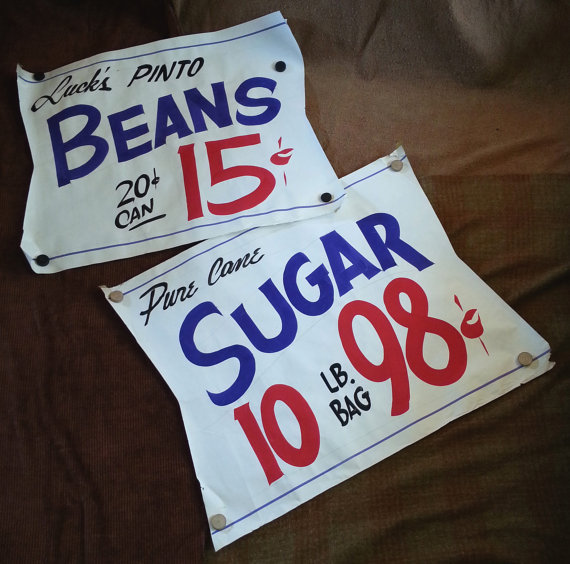
I think my attitude toward what and how much to put on a slide probably stemmed from my father and his grocery store sign-making. Back in the day, his local supermarket chain was not of the size to have giant prepared signs to display; rather, he had to draw all the signs himself, even the giant price signs that used to appear in the windows. My dad had worked in grocery stores on the West Coast and up and down the Mississippi River, and somewhere along the line, he developed a real talent for making signs.

The process was typically performed at our house, and it followed something of a regular schedule. On Sunday nights after dinner, my dad would roll out sheets of white paper, uncap several very odiferous Magic Markers, and begin the magical process of sign construction. The TV was always on in the background, and I remember one series of signs that was drawn with Billy Graham's crusade playing. (Reverend Graham's delivery, along with the aroma of Magic Marker, could not but result in bringing one higher and therefore closer to Heaven.) I was fascinated by the skill and speed with which my dad drew these signs. It was as if he had an invisible stencil that made each sign consistent and perfectly well placed on the sheet of paper. He also drew smaller end-display signs that were equally as polished.

On several occasions, Dad let me help with the sign making. I was only about eleven or twelve, and although I tried in earnest to duplicate his style, my signs always seemed a little off kilter compared to his. But my dad, being the kind of guy he was, always put my signs in with his and displayed them in the store. I'd go look at them and think that they were close but no cigar. Still, I appreciated his thoughtfulness.

One of my dad's most entertaining signs was one that he drew when the price of chicken skyrocketed due to short supply. The only chickens that the store could get were very small, rather like oversized Cornish game hens. My dad drew a sign to display above them that read "F.B.I. Chickens," and underneath, it displayed some price per pound that I cannot remember. One day, a female customer asked my dad what the sign meant, and in his typical humorous nature, he replied that many of the parts had been redacted from the chickens and that they were therefore classified as F.B.I. Chickens. I'm sure the customer was quite pleased with the answer, although I heard this story second hand, so I don't know for sure.

I think the lesson from all this is: display with style, but make the point. Sure, you cannot buy a loaf of bread for 25 cents any more, but you can refrain from filling your PowerPoint slides with cut-and-paste excerpts in eight point font from Encyclopedia Brittanica. Make some nice, easy-to-read presentations. And if you need to redact some of the text, just be sure to note that somewhere, in order to minimize questions from the audience.

Saturday, September 22, 2018

The Black Sheep

Every family has at least one member for whom conformity to the perceived norm is simply too much of a stretch. In our case, there was one quite memorable black sheep: my Uncle Clay.

Clay Wells was a Navy man who married my great Aunt Mary and thereby became part of our family. There's no denying that Clay marched to the beat of a different drummer, yet he was an upright, honorable man with a dry sense of humor and a passion for good living. But from the beginning, it wasn't all peaches and cream for Clay and our family.

According to Grandma Estelle, our family historian, her younger sister Mary had fallen in love with a man sometime during the late 1920's or 1930's, and they became engaged to be married. No one was really clear about exactly what happened, but shortly before the wedding was to take place, Mary's fiance committed suicide. Mary, gentle and kind to a fault, was devastated. Our family was close and offered constant support, and eventually, Mary's spirits were lifted. A few years later, she met a young man named Clay Wells, and they married.

Estelle's accounts of Mary and Clay's early years together made me realize that from the beginning, Clay was something of an outcast. In good Southern tradition, there was never anything said directly to either of them in that regard, but there were stories. One of my favorites involves an incident that occurred some time during the 1940's. 

At the time, Uncle Clay was selling automobiles at a large dealership on Union Avenue in Memphis. Union Avenue was, and remains, a major thoroughfare in the city. There are few times when the road is not busy with crosstown traffic. As the story goes, my grandfather Leslie, Estelle's husband, purchased a car from Clay one day, and everything was going well until he headed out onto Union Avenue on his way home. Before he had gone even a mile, smoke appeared from under the hood, followed by flames -- the car's engine was on fire. Leslie, furious by this time, had the car towed back to the dealership and gave Clay a piece of his mind. From that day forward, my grandfather was convinced that his brother-in-law had intentionally sold him a bum car.

Eventually, Mary and Clay settled into a comfortable life in Memphis. They became successful real estate agents and owned a beautiful home on North Trezevant Street in Memphis, only steps away from Overton Park, the city's lush in-town greenspace. In the early 1960's, we would visit with them often. Oddly enough, my kindergarten teacher and her husband lived next door, so on occasion, we would drop in there as well. Mary and Clay loved fishing and often would travel to Florida to pursue their hobby, always bringing back fresh catfish, which would be served with fried chicken and hush puppies at one of our favorite regular family gatherings, the back yard fish fry.

Fish fries were absolutely delightful, and once we had our fill of fish, we would retire to the living room, where one family member after another would tell stories. Clay was an excellent storyteller who just happened to possess a rather far-reaching knowledge of serious literature. Often, when just he and I were talking after a big dinner, Clay would ask if I had read books by authors whose names I was beginning to hear in junior high school, people like John Steinbeck and James Conrad. I found that I was beginning to develop a strong interest in literature, so I relished the opportunity to talk about it, and Clay always seemed to offer yet another author or book to explore.

Despite his somewhat intellectual bent, there's no escaping the fact that Clay, like all of us, had his unusual habits, and one of them I found especially entertaining. Back in the day, due to less than perfect preventive dental care, many people were fitted with dentures as they approached their later years. Clay was no exception, but his dentures did not fit well enough for him to make it through a meal without incident, so he generally opted to remove them prior to eating. The result of this was that he often mixed up the contents of his plate into a singular mushy entity, which he would consume while the rest of us methodically ate our easily identifiable meal elements. Behind his back, Grandma Estelle would say, "Honey, I just hate what Clay does with his food." But being good and proper Southerners, we never said anything directly to him; instead, we simply looked on in befuddled amusement.

The flaming car incident remained a stumbling block in the relationship between Uncle Clay and Grandpa Leslie. One weekend in the late 1960's, I was staying with my grandparents. By this time, Leslie had suffered two severe strokes and was confined to a wheelchair, where he would consume six-ounce bottles of Coca-Cola and Pall Mall cigarettes nonstop as he sat by the front window of their North Hollywood Street home. Early one afternoon, Mary and Clay pulled up in the driveway, and Leslie said to Estelle, "Maw...get my gun." At that point, it was clear to me that the feud would never end until either Leslie or Clay had passed from this earth.

Despite the fact that people always saw Clay as something of an outsider, he and Mary appeared to have lived full and happy lives. From my youthful perspective, I appreciated his eccentricity, and I think that Clay was good for us -- he brought to our family a wonderful sense of humor and tons of delectable fried catfish. Intentionally or otherwise, he provided a bit of comic relief during the turbulent days of the 1960's. I miss him, and I never see a Steinbeck book without thinking of him.

Oh, and just for the record, I have a cousin who sells cars. Several years ago, we bought one from him. It has never, ever caught fire.

Tuesday, July 24, 2018

Listen to All That Quietness

I don't think my father ever realized that he was a wordsmith of sorts. I've mentioned before on this blog how he liked to subvert normal usage and pronunciation of common words, and I'm sure it was all in good fun, but he really did seem to enjoy uttering profound, folksy statements at just the right time. One day, while vacationing in Hot Springs, Arkansas, we turned off the Chevy and stepped out at a scenic overlook in the Ouachita National Forest. It was absolutely still, and as my dad took in the glorious view, he said simply, "Listen to all that quietness." I'm not sure at that time that I had ever heard the word "quietness" used in a proper sentence, but my dad really hit it on the head with that one. There was not a sound to be heard anywhere. We stood there for a few minutes looking out over the verdant scene in front of us and then got back into the car and returned to Hot Springs for some "diamond" shopping. (Hot Springs mines its own diamonds, which are actually faceted rock crystal, but they look splendid to the naked eye.) I remembered that "quietness" thing.

It may come as a surprise to many of you who know me, and particularly to those of you who have worked with me, but at my core, I'm really all about quietness. Sure, I'm as ready as anyone to engage in some serious (or sometimes, not so serious) storytelling, but I absolutely relish solitude. This is probably one of the reasons that walking is one of my favorite hobbies. It's for the most part solitary, and even when I'm plugged into 99% Invisible, The Memory Palace, or some other favorite podcast, I can always remove the headphones and snap right back to peace.

When I'm engaged socially, I'm totally there. I grew up as a rather shy child, and with the exception of a few close friends, I didn't really reach out to people much until I was in fifth grade, at which point I decided I wanted to become a secret agent and would do anything in my power to get there. I guess the fact that I didn't (and still don't) have a penchant for guns and violence probably kept me from pursuing that as a career. But playing secret agent got me involved talking to other kids in my class, and it went on from there. I experienced the awkward years around seventh and eighth grade and clammed up a little then, but by tenth grade, having found a group of seniors who accepted me as one of the cool kids (from a student government and political interest perspective, that is), I was going full throttle. Strangely enough, in college, I tended to be rather quiet except around my closest friends in the dorm and elsewhere. I didn't have the "rah-rah" experience at college, because a) Northwestern never won football games, and b) I was too busy studying neurons. When I entered the working world, however, I got my social skills back and have since, for the most part, enjoyed being in that space (as they say in the business world).

#   #   #

While walking this morning, I was listening to a Super Soul Conversations podcast (surprise!) hosted by Oprah Winfrey in which she was discussing with spiritual teacher Eckhart Tolle the concept of living in the moment. This is a popular topic these days, given our constant bombardment with information in all sorts of formats and our incessant need to keep ourselves busy. You can't go fifty feet without hearing someone say that we all need to be more mindful, and I totally agree with this idea. The question is, how do we get there? One of Tolle's basic tenets is that stillness is a very necessary part of our existence. He believes that we derive strength from being restored in peaceful moments. And yet, we often bypass opportunities to take a quiet, reflective moment to ourselves, either out of necessity, as in work situations, or because we just don't think to do it. I suspect it's often more of the latter.

In the last couple of years, I've had a lot of time to reflect on this kind of thing. I've spent days and weeks in compromised physical situations where there was sometimes no other choice than to relax and reflect, and although I wasn't particularly fond of the way this all happened, it has had a very positive effect on me. I have always been guilty of sweating small stuff, but after a weird bout of pneumonia and, only one year later, a series of eye surgeries, almost everything tends to look like small stuff, and for the most part, I've adapted. I don't sweat nearly as much now, unless it's 95 degrees and I've underestimated the duration of my walk.

Don't get me wrong: there is nothing I enjoy more than getting together with family and friends. To me, it is the very essence of life. When I am with other people, tipping a glass or having a wonderful dinner, time seems to stand still. Jimmy Buffett has a song called "I Wish Lunch Could Last Forever," and I can totally relate to that. And yet, when I'm out walking with just a well-applied layer of sunscreen, my headphones, and sunglasses that I've yet to break, time stands still in its own way. And after that time of (relative) peace and quiet, it always looks like a whole new world. It's been this way ever since I started serious walking back in 2005, and I have no reason to believe it will ever change.

Listen to all that quietness.

Friday, June 15, 2018

Doing Shots with Mickey Mouse

For some unknown reason, I can remember events that happened many years ago with remarkable clarity. I cannot recall exactly what it is that I need to pick up this afternoon at the grocery store, but I can remember exactly where I was, and what toy I was playing with, when I heard that John F. Kennedy had won the 1960 Presidential election. It makes no sense, but it comes in handy sometimes.

Back in 1959, when I was one month shy of my fourth birthday, my parents and paternal grandparents decided to take a car trip from Tennessee to California to see my uncle, aunt, and cousins. My mom and dad had lived in California when I was born but had moved back East several years later, so in addition to visiting my dad's brother and his family, they also wanted to get back out West to see some of their favorite places. My dad had recently purchased a 1957 Chevrolet Bel-Air, shiny yellow with lots of chrome and a big old V8 under the hood. It was a powerful, yet comfortable car, but it was also produced during a time when air conditioning was a relatively new thing, and our car didn't have it.

And so it was, on a sunny morning in April, 1959, we headed west from our home in Dyersburg, Tennessee, with my dad driving, my mom in the front passenger seat, and yours truly in the back, sandwiched between my grandmother and grandfather, who by the way, were always impeccably dressed. We crossed the Mississippi and headed into the wilds of Arkansas.

My parents were savvy about car travel, having crossed the country many times on their own, so before we left, they purchased a couple of toys for me to play with on the trip. One, designated as the westbound toy, was a doctor's kit, and the other, which I was supposed to keep wrapped until the return trip east, was a plastic toaster that could be disassembled and reassembled. Once we had gotten some miles behind us, I pulled out the doctor's kit and got to work.

It's worth noting here that in those days, just about every other child born in the United States had some type of allergy or respiratory issue, and I was no exception. I was constantly being taken to the doctor, a wizened older fellow in downtown Dyersburg who would give me a shot in my buttocks (as Forrest Gump would say), then "allow" me to go home until the next poke session. The shots never seemed to do much, but I started to take them for granted as part of life.

Since our California trip would clock in at nearly 1,900 miles each way, and given the fact that I had no siblings, I brought along the only friend that would fit in the car with me and everyone else, a little squeezable plastic Mickey Mouse. He wore his trademark red pants but had long since lost his shirt, which was a good thing, since a) the car had no air conditioning and b) we would be driving through the desert. Almost immediately upon opening the doctor's kit, I started giving Mickey shots. I was concerned for his health, and it kept my little brain occupied knowing that I had to care for him on a regular schedule. In effect, it made the miles tick away. Mickey got a shot about every hour or so, and this amused my parents and grandparents alike.

We had many adventures on that trip. Mickey and I saw Hoover Dam, a vestigial version of Las Vegas (I still remember the old Sands and Golden Nugget signs), and the Grand Canyon. We even survived a flat tire in Needles, California, which is notable for often being the hottest place in the United States. Finally, after several days of driving, we made it all the way to Los Angeles and marveled at how anyone could grow a palm tree right in their front yard. We watched TV the night that my mom and dad went to see Lawrence Welk, and we saw, right there with our own eyes, my mom dancing with Mr. Welk. Mickey seemed to be doing well in California, so I pulled back on the shots schedule to give him a little room to enjoy himself.

After a couple of glorious weeks, it was time to head back East, so we said our goodbyes, and I resumed Mickey's shots, just to be on the safe side. I also opened the plastic toaster and began disassembling and reassembling it between administering shots. I was one busy guy, just let me say.

Everything was motoring along well until we got to Needles, where once again, upon entering the city, we had a flat tire. We got that fixed and left town, then headed east. It must have been about 30 or 40 miles before I realized that Mickey was missing, so my dad (and I will never forget this) turned the Bel Air around on an Arizona highway and headed all the way back to our motel in Needles, where I found Mickey safely nestled in the bed sheets. We got back out of town with no further tire damage.

I don't remember much about the trip back home, other than the fact that my grandmother put sheets of comics from the newspaper up on the windows to shield us from the desert sun. My grandfather, never a stitch out of place and almost always in a good mood, would make sly observations from time to time that would keep the rest of us reasonably happy, given the close proximity of our seating arrangements. My mom and dad seemed to have gotten their fix of California, at least enough to sustain them until their next trip out, which, as it happened, wouldn't be for another ten years.

I guess we often take family time for granted when we're younger. But I still remember so much of that trip, the joy on my parents' and grandparents' faces when we got out of the car in Los Angeles and saw our family. The moments we shared were all ours, and even Mickey was a part, thanks to some good proactive health care on the part of his owner. The trip was so worth it.

If you're headed out of town this summer, be safe, and I hope that you experience, to borrow an old Esso phrase, "Happy Motoring." I also hope that you can make some memories of your own, so that one day, you'll have some stories to tell, regardless of whether regularly scheduled preventive healthcare and appliance maintenance are involved.

Wednesday, May 23, 2018

Mrs. Keltner and the Lightning

Of all the awe-inspiring forces of nature, lightning is my least favorite. I am genuinely terrified of its potential for sudden destruction, and I will do almost anything to avoid going outside when it appears. But it wasn’t this way before 1963, the year I started third grade.

Mrs. Keltner was our third grade teacher, and if memory serves me correctly, she was a fairly nice lady. She reminded many of us of our grandmothers, in that she seemed to watch over us like a flock, doling out practical advice whenever the opportunity presented itself. One of the things about which Mrs. Keltner was most concerned was our exposure to lightning.

Before I was in Mrs. Keltner’s class, I have to admit that I hadn’t given lightning much thought, but only a few weeks into the school year, she got into high gear with lightning warnings. She told us that during a thunderstorm, we should not ever go outside, stand close to a window, or even bathe or take showers. I translated this last admonition into not going anywhere near the bathroom or running water in general. In short, I truly internalized Mrs. Keltner‘s advice, to the point where I became deathly afraid of lightning, even after I’d finished third grade and headed on to fourth. And fifth. And sixth, and so on. But one memory stands out above all others in this regard.

The summer after I’d finished third grade, our family took a vacation to the Ozark Mountains. The trip was going fairly well until late one afternoon, when my parents decided to go to an outdoor play called “The Shepherd of the Hills,” which was held on the outskirts of as-then-undiscovered Branson, Missouri. We drove down a gravel road to a field that was set up for parking, and just as we were about to leave the car, I saw on the horizon one of the meanest looking storms I had ever seen. To this day, I have seen nothing that compares to its sheer ugliness. The sky had turned a deep, dark green above a narrow ribbon of sunshine. It looked unbelievably disturbing, and I was terrified. I began crying hysterically, fearful that my parents would insist that we leave the car to watch what by now I am sure I had dubbed “this stupid play.” Of course, my parents would never have done such a thing, but still, I was beyond help and was having a total meltdown.

"The Shepherd of the Hills" in progress
As with many summer storms, the green cloud turned gray, the rain poured in sheets, and then the whole thing was over. It was then safe to leave the car, but there was still the play to endure.

When you are nine years old, even an hour seems like an eternity, but seriously, "The Shepherd of the Hills" had to have lasted almost three hours. For all that time, we were perched on hand-hewn, uncomfortable, wet wooden benches. The play seemed to go on forever, and although it was billed as family entertainment, I couldn’t really follow the plot, but at least there was no lightning, so that was good. When it was over, I told my parents how sorry I was that I had acted so dramatically, but they seemed to understand, and by the end of the evening, the vacation was back on track.

In the many years since, I’ve seen my share of inclement weather, having lived through Memphis tornadoes, Chicago blizzards, and some wicked Southern heat, but still, nothing rattles me like lightning. If I am parked only twenty feet from the entrance to a store or restaurant during a storm, I will generally run like hell to the door, effectively folding time and space to get inside. I know Mrs. Keltner would be proud that I have heeded her warnings. Every time I see broadcasts from the “Severe Weather Center," which in Atlanta generally runs up the flag when we are having no more than an eighth of an inch of rain, I think of her and how she cared for her flock.

Bless you, dear Mrs. Keltner, for your lightning obsession. I’d rather be safe than sorry. And by the way, I just looked up “The Shepherd of the Hills” on Wikipedia, and you know, the plot doesn’t really look too awful. Maybe I’ll give it another try, but this time, I’ll wait until the sun is shining.

Tuesday, March 13, 2018

Put Another Dime in the Magnavox

Today at lunch, I stopped by McDonald's, and as I walked in, pianist Floyd Cramer's rendition of "Green Green Grass of Home" was playing. I thought immediately of my dad, because Floyd Cramer, of whom many people these days have probably never heard, was one of his favorite artists.

Although not a musician himself, my dad had a fairly broad interest in music (guess where I got that from). He listened often to the likes of Eddy Arnold, Chet Atkins, Floyd Cramer, Boots Randolph, Glen Campbell, John Hartford, and Danny Davis and the Nashville Brass. He took such an interest in Davis that he decided to make a major upgrade to our house in 1969 by purchasing a Magnavox console stereo. It wasn't a room-filling, Cadillac-length model, because we didn't have that much room, but boy-hidee, did it ever sound fine. The day it was delivered, my dad played his favorite albums, one after another. That was a landmark day on Chatwood Street.

My mom had played piano since I could remember, and she, too, was a music lover. Her interests were a bit more tame: Jeanette McDonald and Nelson Eddy's rendition of "Indian Love Call", anything by Lawrence Welk or 101 Strings, and all the old Irving Berlin favorites. But when it came to stretching musically, my dad was in a league all by himself. He would be listening to Eddy Arnold one day, Booker T and the MG's the next, and Elvis as time permitted...it was fabulous.

Growing up, I didn't learn much about sports, because even though my dad watched football, baseball, basketball, and anything else involving a ball, he wasn't much on imparting his sports knowledge, so my education is that area was (and is) still somewhat lacking. But when it came to music, he would not hesitate to play it, talk about it, and best of all, get us concert tickets. We saw so many people: the Memphis Symphony was always hosting a guest musician, and we attended those concerts about once a year. Our annual Mid-South Fair featured a rodeo, and at the "halftime" of the rodeos, popular entertainers would be featured. (One year, I actually saw the Three Stooges, with Moe, Shemp and Curly's replacement.) In 1968, we saw Johnny Cash at the rodeo. I still remember that as we were driving away from the Mid-South Coliseum after The Man in Black's show, we passed his limo and saw him sitting in the back seat, wearing sunglasses and looking out the window. He was a character of unparalleled dimensions.

One night in the early Sixties, my dad had a treat for us. He showed up at the house after work with a bag of Krystal hamburgers, and since they'd gotten a little chilled in transit, we reheated them in our oven. We finished up dinner quickly that night because he was taking us downtown to the Ellis Auditorium to see Louis Armstrong, the legend, the real Satchmo. I was only about seven years old, but I was so excited that I could barely control myself. We had great seats, and I'll never forget the way Satchmo took the stage, pulled out that white handkerchief, raised that gleaming trumpet, and started making magic.

I recall only one time that my dad did not enjoy music. One night in the early 70's, I was listening to Chicago's second album on the Magnavox. In those days, Chicago was one of the most popular bands in America, and their music was all over the radio. We had brought my mom home from the hospital only a day or two before -- she had been there for over a week -- and my dad and I had a quiet dinner. Afterward, he went to check on my mom, and I put on some Chicago, at what I thought was a reasonably low volume. A few minutes later he emerged from the bedroom and asked me to turn down the music. I did not hesitate to comply, of course, but I remember that he said, "Son, your mom is trying to rest. Do you want her to get well?" I didn't play any more music for a few days, until I saw her spirits rise. It was a moment that stuck with me, because my dad was a gentle man, and he didn't often get irritated. I figured he knew the situation better than I did.

One day in the late 1960's, while we were on a trip to Nashville, my dad took us to the newly opened Country Music Hall of Fame and Museum. This was nirvana for him, and he had a running commentary while we were there. Since Memphis was home to rockabilly, blues and soul, we actually had to make the four-hour drive to Nashville for true country immersion. Whenever I'm back in Nashville, I think of that trip and his stories of going to the Grand Ole Opry at the original Ryman Auditorium, where he would listen to the legendary Roy Acuff singing "The Great Speckled Bird." It was, in my mother's opinion, one of the worst songs ever written. For that reason, my dad would bring it up over and over, and my mom would just roll her eyes and move on.

Even though it might have taken me until the age of 32 to really understand what a first down in football was, I appreciated a wide variety of music. Just like with people in general, my dad taught me that there were talents everywhere and that everyone, regardless of heritage, background, or belief, had something to contribute to the whole. He would be so proud of my daughters today: Sarah and Hannah both recommend music to me on a regular basis, and it runs the entire gamut of recorded sound. I am so grateful for that, and now that music streaming services exist, I don't have to wait to get to a music store to hear their recommendations -- I can simply enter the names in a search box, and off we go. My personal music library is constantly being enriched because of their contributions.

So there you have it: that's why I still fall asleep during "important" football games but somehow knew about Tuvan throat singing well before 1990. Put another dime in the jukebox, baby...live life big.

Sunday, September 24, 2017

The Think-A-Tron

Growing up, I don't recall ever making Christmas gift wish lists. I'm still slow to complete them, as my family will attest. I think this is because in my early years, my parents were just humdinger Christmas shoppers. We weren't a wealthy family, and during the year, we didn't exchange extravagant presents, but at Christmastime, my parents always amazed me with the gifts they found and gave me, many of which I did not know were on the market until I actually found them under the tree. One such toy was the Think-A-Tron. I received one for Christmas in 1962 and was immediately taken with it.

The toy had been developed by Hasbro and introduced onto the market sometime during the late years of the Eisenhower administration (an era which I actually remember, although that is material for another blog post). Anyway, the Think-A-Tron was something of a magical device. It consisted of a gray box resembling a computer punch card reader -- all computers used punch cards, or "Hollerith cards", at that time. The idea was that you slid a tiny punch card containing several questions (A/B/C or True/False) into a tray, then pushed the tray into the machine. Once the card had been fed, the machine would begin whirring, and a "digital" display would flash, finally settling on the letter of the correct answer.

This may all sound incredibly simple, but the Think-A-Tron came with about 500 punch cards, so running through them was a pretty good mental workout, and some of the questions were actually a bit challenging. They were all sourced from the Book of Knowledge, a popular children's encyclopedia at the time. and each card had questions printed on both the front and rear sides. One side contained the A/B/C question, the other the True/False question. Each card was pre-scored with paper dots which could be punched out to resemble a Hollerith card, but those dots weren't what actually controlled the Think-A-Tron; rather, a small notch on the side of each card determined which letter the toy would display. Once the player figured this out (and it wasn't readily apparent), determining the correct answer became something of a no-brainer. Still, the machine, with the commotion it created, was endlessly fun to watch, and I remember that most of the time, I purposely did not look at the notches so that I could test my answers.

The Think-A-Tron was my big present that year, and it was somewhat expensive for the time, ringing in at around $10.00. In today's currency, due to the calculated 713% rate of inflation since 1962, it would be worth about $81.00. In those days, people didn't get iPhones for Christmas; there were no credit cards, so things had to be bought with cash. Given that, I was eternally grateful to have received my Think-A-Tron, and I'm pretty sure that I stayed on my best behavior well throughout 1963 and maybe on into 1964.

Having worked in the information technology field since 1979, I'm wondering if that Think-A-Tron had anything to do with my eventual chosen profession -- I think it probably did. I remember the nights of studying for midterms and finals in college, memorizing those organic chemistry reactions, analyzing nervous system action potentials, trying to visualize objects in multidimensional calculus, that sort of thing. I was actually a serious pre-med student for most of my time at Northwestern. But it's interesting that in the end, what won out for me was a field I'd never considered, one for which my interest was most likely sparked at an early age by that clever little Think-A-Tron, with its two D batteries and its flashing lights. If I ever find one of these things in an antique shop, it's a done deal.

Note: Click here if you'd like to see a working demo of an actual Think-A-Tron.

Tuesday, July 25, 2017

The Imitation Game

I have this thing for accents. I love listening to them and imitating them, sometimes in my own head, sometimes out loud. I have to be careful when I use them in the latter context, so as not to offend anyone, because that is never my intention. I simply find speech patterns a fascinating subset of sociolinguistics. I've done this for so long now that our daughters call it "doing The Voices."

I've tried to remember when this habit started. I don't recall imitating accents as something that I did in my high school or college days; rather, I believe it began when I was traveling for business in the early 1980's. In those days, I was the information technology manager for a Chicago company with five regional offices across the country: two in Chicago and one each in Boston, Los Angeles and Atlanta. I spent significant time on the road, typically visiting each location several times a year for the better part of a week at a time.

My job was very interactive. Unlike today's IT jobs, which are largely defined by remote access to servers, cloud-based applications and toolsets, much of the work in those days was done on site or over the phone. I was in charge of the company's systems development and operations, so I spent tons of time talking to people, and aside from the knowledge I gained by sharing in the day-to-day experiences of my fellow employees, I also began to appreciate the stories they would tell at lunch or after work. The essence of some of their stories simply could not be communicated without occasionally using their own words, with their own inflections.

I learned that every region has an accent and cadence that is particular to its manner of speaking. It's actually quite humorous to witness those situations when the speaker denies that he or she has a regional accent, because we all do. There's nothing wrong with it, because truly, there is no right or wrong in speech patterns. But I still marvel at the fact that people in some parts of the country believe themselves to be accent-less, while many others, although fully appreciating their own lingual specificity, believe that there is one bonafide Southern accent. I mean, we must have over a hundred Southern accents, dag-nabbit.

Back when our daughters were younger and we were taking extended car trips to places like Pennsylvania, Illinois and Vermont, I would occasionally lapse into an accent typical of the region to which we were traveling. I saw it as my bounden paternal duty to give our children a taste of what to expect so that they wouldn't arrive at their destinations as strangers in strange lands. This technique alternately delighted and horrified the girls.

On one particular trip, as we drove through central Mississippi on our way to New Orleans, I began speaking with a Justin Wilson accent. Wilson, as you may recall, had a long, successful career on public television as the host of "Louisiana Cookin'," a show that we watched almost every Saturday. His favorite expression was, "I gar-on-tee." I spent the larger part of our drive to "Nawlins" that afternoon sprinkling my language with faux-Cajun talk, which came to me somewhat easily, since a) it was something my dad used to do, and b) I had watched so much Justin Wilson. Anyway, Sarah, who was 16 at the time, finally had enough of it and said, "Dad, stop it. They don't talk like that down there." I knew better, but I acquiesced.

Several hours later, we pulled into New Orleans and checked into the Pontchartrain Hotel, road-weary but with still enough energy to do some exploring. Our younger daughter Hannah and I went one direction, while Sarah and my wife Karen headed the other, and after about an hour and a half, we reconvened at Jackson Square. Sarah pulled me aside and said, "Dad, I apologize for what I said earlier...they do talk exactly like that down here." I laughed and for a moment felt that rush of endorphins that accompanies every successful parenting effort.

Hannah also has a regular line about my habit, and it never fails to make me laugh. We'll be walking somewhere, or maybe sitting down to dinner in a remote location, and I'll break into an accent. She'll say, "Stop it, Dad! People actually talk like that here!" This causes me to either immediately cease or continue at an accelerated pace, depending on the situation and/or local population density. I do try to exercise discretion in these situations, however, because Hannah has a very good sense of timing and has probably kept me out of many a sticky and potentially life-threatening linguistic confrontation.

Probably at no time did this habit of mine provide more delight to my family than one Christmas season about ten years ago, when the girls, Karen and I visited the Biltmore House in Asheville, North Carolina. After a grand tour of the beautifully decorated mansion, we opted for dinner at a local Carrabba's Italian restaurant. Although we were in an artsy town in the middle of the mountains, something made me use (unconsciously, I might add) my Old Jewish Man accent, which I learned from my friends in college at Northwestern, many of whom were Jewish and would lovingly imitate their older relatives all the time. Every time the waitress would stop by our table to ask how the food was, I would answer with phrases like "Such a lovely meal" or "It's unbelievable...I can't get enough of it," always intoned in the style of Jackie Mason or Henny Youngman.

We finished our dinner shortly before the restaurant closed, and our waitress made one last loop around the dining room to pick up everyone's check. As she stopped at each table, she said, "Merry Christmas!" Finally, it was our turn, and as she approached the table, she paused for a moment and, obviously thinking twice, said, "Happy Holidays!" The girls looked at me with this "Oh, my God" stare, but all I could do was laugh. The story has since become a classic in the annals of our family history, and I have to admit to being somewhat proud of myself for sounding so convincing.

At any rate, I have this habit, and I don't know if it will ever stop. When Sarah brought her new boyfriend Tom to our house for dinner one night in 2008, she asked me to do The Voices. I was a bit hesitant, because I didn't want to do anything inappropriate, but she assured me that Tom would like them, and he did. They've now been married almost five years, so I guess I'll keep doing them. Besides, my own accent is somewhat distilled and needs a little spicing up now and then.

Sunday, May 28, 2017

Mother Machree and Helen Lucille

My Aunt Ida Mae outlived three husbands and one boyfriend. Divorced at 47 and living in the small Tennessee town of Trenton, she took it upon herself to enroll in a local beauty school and ended up opening her own shop, "Coiffures by Ida," in the mid-Sixties. At the time, we all asked her what "coiffures" meant, and she said it was just a fancy French word for hair styles and that she thought people would notice it more than "Ida's Beauty Shop."

Ida's business flourished. She converted the living room of her High Street house into a salon, and she proceeded to build a loyal contingent of customers who would walk up the steps to the front door, then come in for their scheduled appointments and of course, a little bit of socializing. Ida had a great air conditioner in the salon, so people liked hanging out there to take a break from the Mid-South heat. All the customers (except for her son Marion) were women, but one day, a well-dressed man came up the steps, and Ida introduced him as her new boyfriend Mac.

It's important at this juncture for me to create a mental image of Mac. Think Monopoly Man. Mac stood only about five foot six, just a bit shorter than Ida, and always wore a starched white shirt, suit vest, and trousers. He generally opted to forego the suit coat, owing to the heat, but he always wore a pocket watch attached to his vest, and he would pull it out to check it from time to time. A retired insurance executive who apparently had lived life on a schedule, Mac was well off and lived in a tidy brick house just down the street from Ida, which made walking to her house his preferred method of "courting." He was, of course, always impeccably dressed.

To say that Mac was entertaining would be a vast understatement. He was a natural comedian who spoke in a rather hybridized accent that was some mysterious fusion of Southern, Cajun and a few other things which would be hard to categorize. His expressions were punctuated by long, drawn-out vowels more reminiscent of the South Carolina Lowcountry than our part of West Tennessee, so I had to believe that he had spent some time there or in some place with a similar accent. We never got around to discussing that, though, because it was his humorous exclamations that preoccupied us. My favorite of his was one that I've never understood, even after years of searching for the meaning online. When Mac was truly surprised by something, he would contort his face into an expression of astonishment and exclaim, "Mother Machree and Helen Lucille!" He drew out the phrase so that it actually sounded more like, "Motha Ma-CHREE and Helen LU-SEAL!"

The only consistent reference I've found to either of the two ladies mentioned in this expression is a definition for Mother Machree. This was the title of a 1928 silent film about a poor Irish immigrant who moves to America. Helen Lucille was not the name of any other character in the movie, and a web search only reveals obituaries for people by that name, none of whom seemed to have acted in movies, although I suppose that would have been possible. At any rate, this Helen Lucille appeared to have had quite an influence on Mac.

# # #

The green neon lights shone against the black night sky on the quiet highway outside Milan. Mac had decided to take Ida, my mother Peggy, my cousin Marion and me out for ice cream, so here we were, off this deserted highway at some place that had "Freeze" in its name. Marion and I ordered soft serve cones dipped in chocolate, and as soon as we had them in our hands, we started devouring them. Mac, on the other hand, ordered a large cone of plain vanilla soft serve, and when the server handed it to him, we all stopped to behold its glory: there, resting upon the top of a humble wafer cone, was a veritable tower of ice cream. It must have been at least eight inches high. Mac looked at it, then with a swipe of his right hand, removed the top half and dumped it onto the ground as he exclaimed, "Motha Ma-CHREE and Helen LU-SEAL! No way I can eat this much cream!" We laughed so hard and so long, until we finally jumped back in Mac's Caprice Classic and returned to Trenton, full of frozen deliciousness.

Mac was not a good driver. My mother especially hated riding with him, and for good reason. He would run out in front of other motorists, veer intentionally off the side of the road, and jiggle the steering wheel back and forth, all the while saying, "This car's tryin' to play tricks on me!" Mac loved to go to buffets on Sunday, so whenever we were in Trenton, he would take us out, insisting that he drive one of his Caprice Classics (as you may have imagined, he had several over the years). These trips were always nerve-racking ordeals. One day, Mac wanted to take me out for a personalized tour of Trenton, and my mom reluctantly agreed. Our brief expedition was highlighted by a drive through the town cemetery, where at one point, as the car veered off the drive, Mac commented, "This car's tryin' to play tricks on me, right here in the graveyard!" We got back home, and when my mother found out where we had been, she was not amused.

But despite his reckless driving, Mac had a good heart. He and my Aunt Ida had some fabulous times together, and until his passing in the early Seventies, he was a constant source of companionship and amusement, not only to Ida, but to us all. Mac was really and truly Ida's boyfriend: after her divorce, she focused on making a living for herself and raising the one of her two sons who still lived at home, and she did well, so Mac was like the icing on the cake. He was a classic gentleman who would come courting at predictable times, and even though not formally a member of the family, he seemed like one to us. After he died, his survivors had little to do with Ida, and although at first she was hurt by this, she recovered in short order and found another husband, and when he died, yet another. They were fine gentlemen both.

Which brings me back around to the point of this story: we all encounter people in our lives who leave on us a lasting impression. At the time, it seems that they will be with us forever, but in truth, we must take advantage of the time we have with them. In my case, I have never met another Mac, although my eyes are always open for someone else of that ilk. I would love it if that were to happen.

Oh, and one more thing: If you know or can find out who Helen Lucille was, please let me know.


Monday, March 20, 2017

Gratis

Just the other day, I was playing the game Hanging with Friends on my phone, and as it happened, my best word to offer up to my challenger at the time was "gratis." That's a word you don't hear every day. Growing up, my dad used it all the time, and I wasn't sure what it meant, so one day, I asked him. His definition was simple: "free."

We didn't pay for lots of stuff in those days. As you may have read elsewhere on this blog, my dad managed a grocery store, and in that position, one benefited from many gratis deals. Food brokers gave away free promotional materials to merchants if they sold a certain level of goods or maintained a particular level of stock for an item, and my father was rather gifted in the art of grocery marketing. He would mark cans of peas that had been selling for 29 cents at three for a dollar, and they would fly off the shelves. Things like that always amazed me.

One way Dad increased sales was with his outstanding hand-lettered promotional signage. Many Sunday evenings, he would make signs at the dining room table. I admired the sleek way he drew 9's, like an elongated oval that fell back on itself. Sometimes I helped make them, and even though mine didn't look nearly as symmetrical or colorful as his, he displayed them nevertheless. Sign making was an art of sorts, and his were very eye catching. So sales were good, and we got free stuff.

Thinking back on the dizzying array of gratis items we received, I realize that we had all bases covered. Here are a few samples of gifts that were bestowed upon our family during the 1960's:
  • Cutlery - This seemed to be a very popular item. We had knife sets "of the highest quality" from faraway places like Japan. (Come to think of it, we had lots of things from Japan.)
  • Flatware sets - We received a few of these, the most notable being a 24K gold electroplated set that was stored in a rolled-up moss green plastic sleeve. This set was reserved for fancy dinners like Easter or the times when someone would bring a new boyfriend or husband over for dinner.
  • The Teem Rabbit - This was an incredible chartreuse and yellow stuffed beast, standing over five feet tall, which my Dad brought home to me one Easter. (Teem was a 1960 Pepsi product, the equivalent of the recently-introduced Sprite from Coca-Cola.) Years later, the rabbit deteriorated somewhat after we had stored it in the attic and birds had nested in its stomach. But that wasn't enough to keep our inventive, packrat neighbor Kyle Davis from asking for it, to which we generously obliged. What he did with it, I have no idea.
  • Dented cans - We received many dented cans of food, many of which were unlabeled. My dad would write the contents in grease pencil on the sides of the cans. My mom could not stand this, because a) she felt that she had no clear idea of what was really in the cans, and b) she did not want us to get botulism from breached can contamination. I shared her concerns.
  • LP's - Occasionally, we would receive gratis records. The one that stands out in my mind is a two-album set of the Chase and Sanborn 102nd Anniversary Edition radio program featuring Edgar Bergen and Charlie McCarthy, which I later found online as an MP3 (you can find anything out there). I still have those LP's.
  • Gum machine toys - It is inevitable in the operation of an urban grocery store that candy machines will be violated and will break, spilling their contents on the floor. The vendors would come and replace all the gum and toys, and in those rare cases, my dad generally scooped up some of the escaped toys and brought them home. I had several boxes of these and played with them ad infinitum.
None of this was very expensive, but oddly enough, I have kept many of the items. My mom had stored the cutlery and flatware at her house, and when she passed away several years ago, we packed them up and brought them home. Our girls are now acquiring the cutlery piece by piece as they set up their respective households.

I know I'll be fine with eventually disposing of all the gratis items except for one, and that's the moss green sleeved 24K gold flatware set. When I see that, I remember how we used it when Aunt Ida brought her boyfriend Mack and later, her new husband Herbert over for dinner. Come to think of it, just like that flatware, Herbert was a keeper.

Friday, December 30, 2011

The Years of Speaking Dangerously

With Dad on the Northwestern
campus in 1975
My father was a native of Memphis -- he grew up in Bartlett, which is now effectively part of the city but was in the 1930's and 1940's an outlying community, a place where country people mixed with city folks.  My dad spent most of his years working in grocery stores, and in that business, he encountered a vast array of people from all different walks of life and parts of the world.  There were Italian truck farmers, Jewish food brokers, Greek restaurant owners, you name it.  He kept his ears open to their accents and expressions, but he didn't stop there -- he turned everyday words upside down and inside out, then used them in normal conversations.  The results were often hilarious, because he didn't hold back.  He would use these expressions when in the company of complete strangers, and this delighted many people, my friends among them.  It goes without saying that he was one of the most popular parents to ever chaperone the Treadwell High School band bus.

For example, I did not know the correct pronunciation of the word "catastrophe" until I was about eight years old, because my dad always pronounced it "CAT-a-stro-phe", with the accent on the first syllable, which to me sounded like something untoward happening to a feline.  It was only when I was corrected by a fellow third grader that I realized the error of my ways and started using the correct, albeit less dramatic, and therefore less effective, pronunciation.

One night, my mom and dad attended an open house at my school, and when my dad got home, he mentioned that the walls of the school were painted "bilious green".  He said this with his characteristic Tennessee/Louisiana accent (although I am not aware of any Louisianans in the family), and I thought it was sublimely ridiculous, so much so that I started using it on my own to describe any less than pleasing shade of green.  At the time, I did not see the connection to "bile", but I just thought the word "bilious" sounded absolutely fabulous on its own.

In our house, my dad would call a hospital a "horse spittle", which my mom always scolded him about because she thought it sounded so rude.  I picked that one up as well, because having not yet attained a more mature level of gentlemanly civility, I thought that I could surely get some mileage out of any expression which evoked a certain element of revulsion.  Some years later, my parents spent quite a lot of time as patients at Baptist Hospital, and I pulled back on the whole "horse spittle" thing after that, having gained a new respect for what hospital employees actually did for a living.

But by far, my favorite expression Dad used was the word "cattywampusided".  Now, the term "cattywampus" is widely used in the South and Midwest to denote a condition of disarray, or more specifically, misalignment, and my father's use of the word remained true to this meaning, but his variation is something I have never since seen in printed literature or heard in spoken English.  I'm convinced that he made it up, and I said bravo, because that was one great slang word.  I still find myself using it from time to time, owing to the weird way it strikes the ear.

My dad would add fuel to the fire by taking these made up words or variations and adding to them some kind of accent, and I seem to have perpetuated that practice.  Truly, it makes for fun at times: I've been wished "Happy Holidays" instead of "Merry Christmas" when a Carrabba's waitress assumed I was Jewish, I've fended off telemarketers by pretending to be a recent immigrant who does not yet have a full command of English, and needless to say, I have no trouble getting offshore support for my electronic devices.  I think Dad would be proud of me for continuing his tradition of mixing it up a little in everyday speech.

So the next time you speak to me, please do not be surprised if I launch into some fake French or Mumbai street speak.  I don't mean anything by it...I'm just carryin' on an old family tradition.

Happy New Year, everyone!!

Monday, October 10, 2011

Sweet Magnolia

My aunt Ida Mae was a remarkable woman.  Twelve years older than my mother, her baby sister, she divorced her first husband and outlived two others, all the while maintaining a relatively comfortable life in the town of Trenton, Tennessee.  Trenton is a small city of about 4,300 located in the northwestern part of the state, not far from Humboldt, home of the West Tennessee Strawberry Festival.  It's one of those places where everyone knows at least a little about everyone else, and that's just fine with the locals, many of whom have spent most of, if not all, their lives in Trenton.

When I was a kid, we used to drive up from the metropolis of Memphis to spend weekends with my Aunt Ida and my cousin Marion.  We had a regular routine: Marion and I would break out a game of Monopoly (for which we'd bent the rules to suit us) and listen to the latest albums he had received from the Columbia Record Club.  It was in this way that I was first exposed to the music of Andy Williams, Herb Alpert, and Johnny Horton, among others.  As the night progressed, we'd find an episode of "Twilight Zone" to give us the chills, then after staying up way too late, we would turn in for a good night's sleep.  Marion was about eight years older than I was, but it didn't seem to matter, and he was a very patient surrogate big brother.

I guess the thing that most impressed me about the whole Trenton clan was Aunt Ida's resilience.  When she divorced her first husband, a prominent town mortician, she was suddenly forced to look for some kind of work to sustain herself.  Looking back, I'm sure that breaking ties with a wealthy family and choosing to remain in the same small community was not the easiest route to take, but Ida was determined to make it on her own, and after all, Trenton was her home, too -- she'd lived there her entire married life.  She chose to go to "beauty school" in the neighboring town of Milan (pronounced MY'-LUN, for all you out of towners).  I remember that on some nights, we'd go meet Ida at the school and accompany her home just after dark, and then we'd feast on barbecue and maybe, if it wasn't too late, we'd head over to the Tastee Freeze for a little late night snack.

When Ida graduated from beauty school, it was time to come up with a snappy name for her business, and she chose "Coiffures by Ida".  Ida said that "coiffures" was a French word, and she thought it would give the name some pizzazz.  After we all learned to pronounce it, the name sort of grew on us.  She opened her first shop on Lexington Street and stayed there for a while, then bought a small house on High Street and did it up right.  The High Street house had a million steps up a steep hill, and the front door opened right into the salon.  Within a few months, it became the destination beauty shop in town, and all the people whom she'd known during her years with her ex-husband's family became her customers -- it was as if they'd never missed a beat.

I learned very early on that most information of any consequence pertaining to Trenton and its residents could be found out by listening in on the Saturday morning appointments.  It wasn't that we would be doing this intentionally, but Marion and I would be playing a game of Rook in the next room, and it was impossible to ignore the accounts of how so-and-so's husband was an absolute no-count or how someone else's niece was wearing something totally inappropriate to school.  We started out watching television game shows, but pretty soon, we discovered that the town news being exchanged in the adjacent salon far exceeded anything we could have witnessed on TV in terms of sheer entertainment value.

Ida was a strong woman -- indeed, several years ago, when she passed away, my cousins and I were sitting around the night before her funeral, drinking wine and reminiscing about the way she had carried herself, how she had pulled herself up by the bootstraps and made a good living, all this in a small town where news and gossip are sometimes too readily exchanged, at least for us city folk.  Her eldest son Joe was wondering if there would be a good turnout for the funeral the next day, and I said that I really didn't think there would be anything to worry about.  And indeed, on the following January morning, with a temperature in the teens but illuminated by a brilliant white-gold sunshine, it seemed that half the town appeared to pay their respects.  And on everyone's lips was the notion that Ida Mae was the definition of a "steel magnolia".  Just hearing that made me so proud of her.

Ida was quite successful as a beautician and married two more times, outliving each of her husbands, and through it all, she remained a strong, beautiful woman, full of self-assurance and love for everyone.  She was more than my aunt -- she was someone who for so many of us demonstrated that regardless of the circumstances, it was never too late to pick up the pieces and make something wonderful out of them.

So, Aunt Ida, I hope you know that if you were here tonight, we'd be heading over to Milan for some barbecue.  And if you wouldn't mind, I'd like to ride in the back seat of the Fairlane and look up at the stars on the way back home.