Tuesday, December 29, 2015

J.E. and the Violet Ray

It was probably a little over ten years ago that I first encountered J.E. He was a close friend of my stepfather and lived his whole life in and around Sevierville, Tennessee, just a stone's throw from Great Smoky Mountains National Park. One morning, I stopped in for breakfast with my stepfather and his friends, who met each morning at the local Hardee's on Highway 411, adjacent to Tractor Supply and Big Lots. They called themselves "The University," owing to their rambling, yet quasi-scholarly opinions on subject matter far and wide.

I observed that one man was highly animated, a major contributor regardless of the topic at hand, and the only name I heard anyone call him was "J.E." On that memorable morning, J.E. related to me a story, the essence of which I will attempt to reproduce here. The language is as close as I can recall to what he actually said.
"Well, Richard, I had been havin' this problem with real bad pain in my arm, so I went to see this feller right up here on 66 (Tennessee Highway 66, which runs north from Sevierville up to Interstate 40). I heard he was good. And he was a medical doctor...he had a certificate on the wall and ever'thing.'
'I sat down and told him what was both'rin' me, and he pulled out this thang in a lo-o-o-ng black box. He plugged it into the wall, and then he run it right over my arm a few times, and just like 'at, the pain was GONE. I mean, it was GONE.'"
Surely, one cannot witness such an account without experiencing a rush of curiosity, and I was no exception. Having told the story to countless friends in the intervening years, I'd often wondered exactly what the device had been. As fate would have it, while browsing a large antiques store here in Atlanta over this past weekend, I happened to see a long black box with a plug coming out of it, so I went over to have a closer look.

Sure enough, I had hit pay dirt. There it was, the same type of instrument to which J.E. had been referring. Within the box was a wand-like tool and a couple of glass tubes, which would appear to be illuminated when inserted into the wand. A hand-written label attached to the power cord read, "Western Coil and Electric Co. -- Quackery -- not intended for use. $124.99." I had to know more.

I Googled the name of the company and discovered that indeed, such devices were commonplace in the early twentieth century and were used in a medical practice known as electrotherapy, which involved applying high voltage, high frequency, low current electrical stimuli to the surface of the body. The machines were collectively known as "violet ray" devices and were manufactured until after the Depression, when the companies who made them redirected their production efforts to making wartime equipment and other assorted electrical components.

Wikipedia provides an excellent description of violet ray technology, which was actually introduced by Nikola Tesla prior to 1900:
"A typical violet ray device consisted of an ungrounded electrical control box that controlled the interrupter and which housed the magneto coil, and an attached bakelite or other handle housing which contained the high voltage coil and an insertion port for attachments. Glass evacuated tubes of varying shapes and for different therapeutic uses could be inserted into the bakelite handle to apply the resulting current to different parts of the body."
Granted, the FDA may have seized all the violet ray devices in the early 1950's, but that didn't stop J.E.'s healthcare professional, Lord have mercy on his soul, from finding the right instrument to treat his patient's ailing arm in the new millennium. Besides, these devices were purported to help remedy everything from brain fog to catarrh, and that's no small feat. Quackery? I think that's jumping to conclusions, a premature assessment. The way I see it, when you've got something that works, stick with it.

Thursday, October 1, 2015

Groomsman

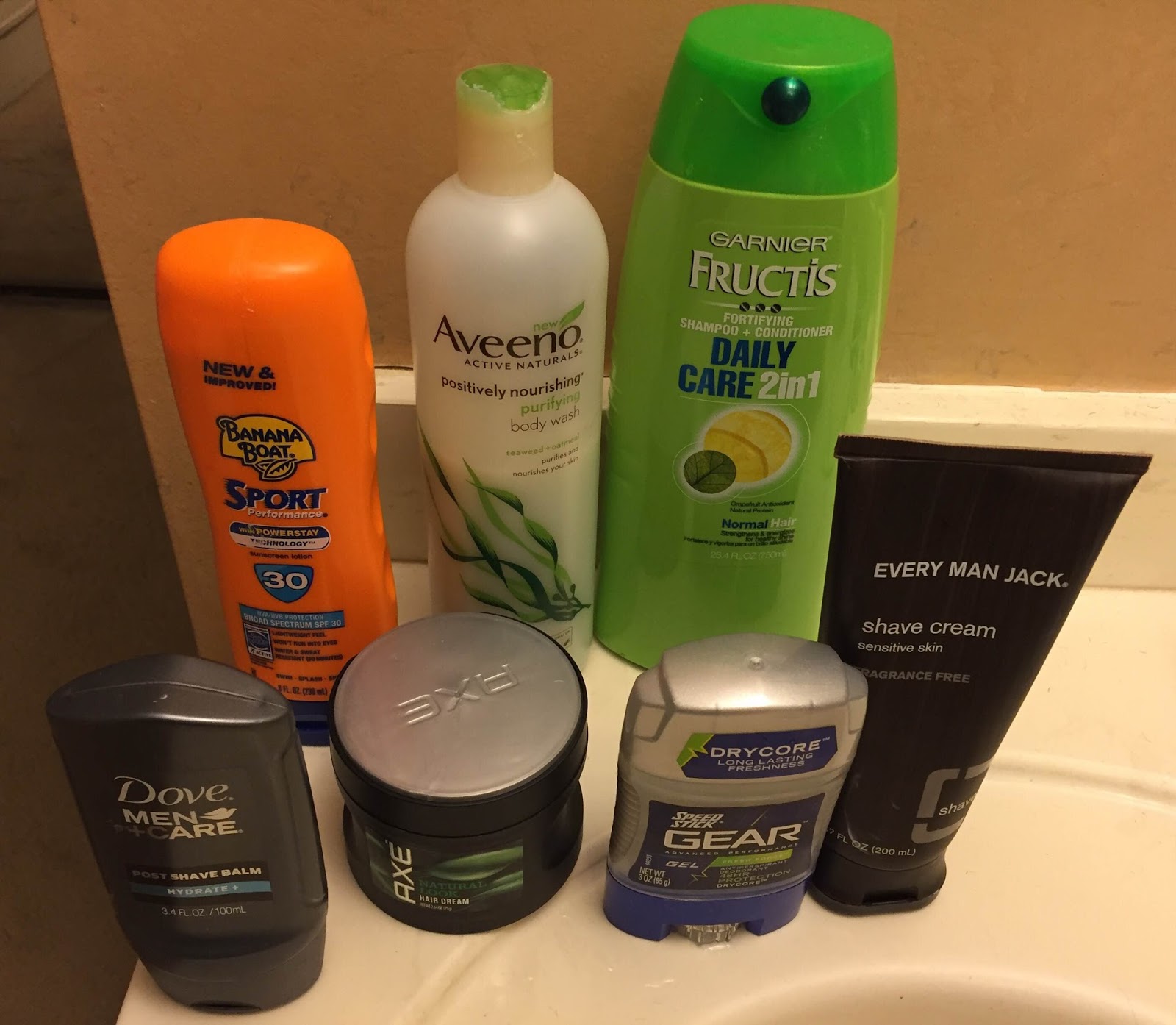
There it is in the picture to the right -- that's my daily personal care armamentarium, at least as of this moment. My wife laughs at me and tells me I use more than the normal number of potions, but hey, "this" doesn't come easy. A guy has to work at it, you know. What's notable about this array of products is that it is not stable. I wish it were, but manufacturers are constantly swapping offerings in and out of their lines, and they seem to be especially reckless with men's products. Maybe they're thinking that we won't complain, but I'm here to let them know that's not the case.

Take after shave. These days, I double dog dare you to find the same after shave lotion or balm twice in a row. For example, I used to use a Neutrogena product that contained a built-in 20 SPF sunscreen, because I figured that would be a good, healthy thing. But within a short period of time, that product had disappeared, only to be replaced with a version which did not contain sunscreen. But now I see that the sunscreen version has returned to the shelves. The same thing happens all the time with all kinds of products. Of course, there are times when you discover something new and good in the process.

One afternoon in the very early 80's, I was shopping at the Old Orchard Marshall Field's in suburban Chicago, and I needed some after shave. In those days, I bought "real" after shave, the kind sold only in department stores. As I perused the offerings, a pleasant female sales associate, some years my senior, asked if she could be of assistance, and when I told her what I was looking for, she asked if I'd ever considered a balm instead of a straight lotion. When I told her I hadn't, she asked me to hold out my hand, and she would apply some Chanel Antaeus to it so that I could feel the texture. When I told her how nice it felt, she said, "Why would you shave your face, then splash it with something containing alcohol?" I replied that I had no answer for that savage male practice and that it stung immensely. She then said, "You should use a balm. It's better for your skin. Women know this." I committed this statement to memory. Needless to say, I left Field's with my first bottle of Antaeus, and it would not be my last. It's still on the market, but it's kinda pricey.

The study of shaving cream/gel/foam is something for which you could probably earn an advanced degree. As you may be able to see from the picture, I've opted lately for a cream. That's what men used to use many moons ago, and I became interested in it when I saw a man shaving with it in an old black and white movie. He was applying something to his face that I could barely see, but it seemed to work. (I don't think he was bleeding, but then again, it was a black and white movie, so it was hard to tell.) Anyway, he was using cream. Shaving gel lasts so long that you become quite tired of its fragrance after a while and want to move on to something else. I once had a can of Edge Sensitive Skin for over a year. Shaving foam, on the other hand, lasts approximately 35 seconds once it's applied to the face and has never been the same since Barbasol, which is still sold, but for something like $6.00 a can. And of course, you can never find the same shave cream twice in a row, except in the case of Cremo, which despite its odd name, smells of citrus and has such a pleasing fragrance that you don't want to ever stop shaving.

Shampoo for guys? Look out. There's an assumption that many men (and this may be true) want to use only one product for body wash, shampoo, and whatever else. The big manufacturers like Old Spice and Axe have catered to this with products which, although probably effective, often have scents which could peel the paint off walls. Other guys may not say anything when they catch a whiff of these, but I could not with a clear conscience wear them around my female friends. They would become distressed and avoid talking to me altogether. Plus, I sing in a choir, and you cannot wear stinky stuff when you sing with such a group, because that might disturb others around you, and they might start sneezing, which is not a good recipe for choral success.

I became more aware of using the "right" fragrance some years ago, when while walking into the office with my friend Swanzetta, she smiled at me and said, "Rico, what is that you're wearing? Mmm-um...ain't nothin' like a good smellin' man in the morning." I laughed, but took that statement to heart. Just as important as the right fragrance is the concept of discretion in its application. Back in the 80's, I worked in an office where one of our compadres loaded himself up every morning with Ralph Lauren Polo, the one in the green bottle with the shiny gold top. There's nothing inherently wrong with this time honored fragrance, but the amount that this fellow used was absolutely staggering. We could smell him heading our way from several aisles away. I vowed back then never to repeat that offense. I don't want to get sued by someone for respiratory damage or because they missed their solo.

So what to do? I'm thinking that maybe I should just stockpile my favorite brands, but I'm wondering if they have a shelf life. I have some eau de toilette that I've had since the 90's, and it still seems to smell okay, but I haven't field tested it, if you know what I mean. I have to be careful, being a baritone and all.

Monday, September 28, 2015

On Being a Morning Person

"Up, boy...rise and shine! Half a day's gone...there's work to be done."
-- Foghorn Leghorn

Back in the day, I'd awaken around 6:45 every morning, weekday or weekend, and it was always cold. Our apartment in Wilmette, a leafy suburb on Chicago's North Shore, had a big picture window that looked out over a pretty little courtyard. I'd make myself a cup of steaming hot coffee and settle down in one of our Pier 1 chairs (such a nice design, so comfy) to read the Chicago Tribune or make a little more headway in the latest book I happened to be reading. Over time, this ritual evolved into something more than a habit...it became a necessity. That was 35 years ago, and still, my mornings have to start with quiet time.

Those of you who spend a lot of time with me know that I rarely sit still, but morning is the time when I get all my thoughts together, and I love getting up earlier than necessary to savor it. I'm definitely not one of those "get to work at 7, leave at 4" people, because I need that time in the morning to putter around. I've been a fan of "Good Morning America" since the late 70's, when I traveled a lot for work and got hooked watching it in hotel rooms before I headed to the office. I can still remember David Hartman and Joan Lunden greeting me as I looked for a tie to match my suit at the LAX Marriott. I've followed the show all through the years and hosts, and now, it doesn't seem like a proper weekday morning until I've checked in with George Stephanopoulos, Amy Robach, Ginger Zee and the rest. They seem like family.

Weekend mornings are grand. There's absolutely no traffic, so I can head wherever in the city without running into a jam, which is quite pleasing. I love to walk for exercise, and I usually engage in my best urban explorations early in the morning. That's when I head into the city and scout out cool neighborhoods, making mental notes of where the good parking places are. By the time I return home, the day is in full swing, traffic has picked up, and I'm ready to go on to the next adventure. Of course, the downside to all this is that by around 2:00 in the afternoon, I'm usually whipped and ready for a nap, so if we happen to be out and about at that time, my wife will often do the driving, since I tend to fall asleep rather quickly (I'm a cat napper par extraordinaire).

This morning, as I write this, I'm beginning a much needed week long staycation, and I'm really looking forward to all these mornings. Today, I slept in until 7:05, but I'm thinking that will not be the norm. Half a day's gone by then, and I don't want to miss anything.

Ciao, y'all.

Thursday, August 13, 2015

I Really Miss Manners


You know, it's funny, but the older we get, the more we begin to understand and appreciate the fundamental things that we are taught in our youth. Some, like looking both ways before crossing the street, might seem natural, but of course, someone has to first teach us those things, and then, hopefully, we remember them. Unfortunately, one thing appears to be missing in "life basic training" for many people these days, and that thing is manners.

Now, before I start to sound preachy or like some old fogey who is out of touch with modern civilization, let me say that this is absolutely not something that applies to all people, and it is certainly not a unique product of today's social climate -- ill-mannered people have always been out there. Nevertheless, it does seem to be rearing its head with amazing regularity these days, both in formal and informal contexts.

When I was brought up in the 1960's and 1970's, manners were an intrinsic part of child rearing. The terms "please" and "thank you" were expected to be part of one's everyday repertoire, to be used freely and actively in all situations. It didn't matter whether you were having dinner with your grandparents, borrowing your friend's bicycle, or buying crowder peas at the local farmer's market -- good manners were just expected, and I believe that in addition to "oiling" social situations, they provided an air of gentility which was far reaching. When I became a teenager of driving and dating age, I was instructed by my parents that I was never to arrive at a young lady's home and honk the horn for her to appear -- that was considered disrespectful and rude. I never questioned things like this, because to be honest, I totally agreed with them. If you can't walk up to someone's front door, why are you visiting them in the first place?

Manners are truly missed when they're not there, and I see this almost every day, even in professional situations. For example, I am amazed at the frequency with which people will carry on private conversations during business meetings. Typically, while one participant has the floor, two other people will begin talking to each other at a normal volume, not in a whisper, and often about something totally unrelated to the topic at hand. They may carry on this conversation for several minutes, oblivious to the fact that others are trying to listen and contribute. Good facilitators are adept at handling such things, but personally, I find them most annoying.

Quite often in the workplace, you'll be discussing something one-on-one with a co-worker, when suddenly, someone will walk in and just begin talking, assuming that their concern is front and center. When I see this, I generally don't say anything, but often, I will either walk out abruptly or give the intruding person a look that says, "Obviously, you were raised in a barn." Maybe I shouldn't do things like this, but I can't help it -- not interrupting peoples' conversations seems so basic to me.

As much as I love social media (and I do), it is rife with instances of bad behavior and lack of manners. This of course comes as no surprise to any of us who spend parts of our days connected to each other via the ether. I look at posting and messages this way: if I would be embarrassed to say something that I'm typing, I simply don't post it. Sure, I may not see that person again for years or maybe ever again, but what if I do, what then? It's awkward to come face-to-face with someone if you've just bashed their candidate or made a crude remark about their dinner preferences, so why even do such things?

I think it all comes down to the good old Golden Rule: do unto others as you would have them do unto you. I know I really appreciate people thanking me, holding the door for me, or asking me whether I'd like the front or back seat when heading out to lunch. I truly believe that if we, as a human race, regardless of our ethnic origins, creeds, or musical tastes, all treated each other this way, it would be a much kinder and more peaceful world. Yes, I know I've gotten preachy in this post, but please forgive me, because this is something I feel so strongly about. I'll do my part for manners by saying "thank you" for reading all the way to the end.

Tuesday, August 4, 2015

Don't Take His Food

I realize that owing to more reasonable air fares and the march of time, many of you have probably never taken a really serious bus trip by yourself. You've probably taken city buses around town, tour buses on vacation, and made those group trips on chartered buses, the kind where you know almost everyone, but nothing quite compares to plopping your innocent self onto a commercial bus for a joyride of an appreciable distance.

Way back in 1977, I took such a trip, from Memphis to Los Angeles, ostensibly to look at graduate schools. I had earned my bachelor's degree at Northwestern University in Chicago and thought that I might like to pursue a PhD in either neurobiology or neuroscience. Two colleges on the West Coast, UCLA and UC San Diego, were at the top of my list. Actually, let's be honest...they really were the entire list by that time.

One afternoon in early October, I called my aunt and uncle in California and asked if I could stay with them while I visited the two schools. They said yes, and also asked if while I was there, I would mind helping them paint their house in preparation for moving my recently widowed Aunt Mary in with them. That sounded like an equitable arrangement, so I called around, finally deciding that taking the bus was a far more affordable alternative to any plane ticket I could find. And so it happened that on a Wednesday night in October, my mom and dad took me to the downtown Memphis Continental Trailways bus station, and I boarded a 7:00 PM bus bound for Los Angeles. My mom had even packed some food for me to take along on the trip, since it would last almost two days with no planned overnight stops.

When you take the bus, it's always a good idea to scan the human terrain, as it were, to determine who your traveling companions might be; after all, you're going to be in this deal for more than the few hours a typical flight takes. It seemed to me that we had a good cadre here: there were a couple of unaccompanied youth like me, a Quiet Young Man in a Service Uniform, and a group of Elderly Ladies Who Appeared to Already Know Each Other. I took the seat immediately behind the driver (you never know when you might have to make a quick exit in these cases), checked to make sure I had all my belongings, and tilted the seat back to a reclined and unlocked position. We pulled out of the bus station and headed west on I-40 toward our first stop: Little Rock, Arkansas.

I had made this trip twice before by car, so I knew what to expect from a landscape perspective. But because it was October and had therefore gotten dark early, one could see very little from the windows of the bus. We arrived in Little Rock a couple of hours later, and it was there that I realized how friendly people could be at bus stations. Complete strangers might walk up to you and want to be your friend, or so it seemed. Feeling that I had enough friends already, I grabbed a snack and headed back onto the bus. We had a new driver, who would take us to Oklahoma City.

We arrived in OK City in the "middle of the night." I recall waiting in the bus station as mysterious destinations were announced over the loudspeakers: places like Wichita, Cheyenne, Fort Worth and Amarillo. There were people everywhere, loaded down with suitcases and duffel bags, and it was only 4:00 AM. Somewhere along the line, I think I grabbed breakfast, but it was so early that I can't clearly remember. We hung out in the bus station for a little over an hour, then boarded the bus for our next stop, Amarillo.

It was important at any given time when at a bus station to keep an eye out for not only one's belongings, but also for others traveling on the same bus, because when your departure would be announced, you wanted to move as a unit to make sure no one was left behind. Given the limited number of people on the bus, you could always tell when someone "dropped off," and hopefully that was always intentional. After a while on the bus, it was like you got to know the people, at least in a casual way. I found that everyone on my bus was quite pleasant, and judging by their accents, they appeared to be from all over the country. Although I maintained my solo seat behind the driver, I did start to talk with a few of them on a regular basis.

We departed Oklahoma City as the sun rose, and we left the Interstate, opting for local highways where, according to the driver, we could pick up more passengers in the small towns along the route. I found this part of the trip fascinating. We passed through rolling hills full of swaying amber grass, every now and then encountering a small town which might have seen better days. Many of the towns looked straight out of the Old West, and were it not for the sidewalks, you could almost imagine horses hitched up while their owners quenched their thirsts at the local establishments. One memorable little town seemed to be built entirely of wooden structures with swinging doors that were only minimally attached to their frames.

At last we arrived in Amarillo, and since it was closing in on lunchtime, our driver recommended a local Mexican restaurant that was one of his favorites. This was common -- as we approached a city, the driver would call out this or that interesting place that we might check out while stopped. Drivers were changed every several hundred miles, so it was interesting to get the varying perspectives of each. In Amarillo, I didn't opt for the Mexican suggestion, but instead, grabbed something lighter and settled in with The Hobbit, which I'd just started to read. As I waited to board for our departure, I became rather engrossed with the first encounter with the character Gollum, and before I knew it, it was time to head out.

Early afternoon found us in Tucumcari, New Mexico. Above the ticket window I saw a small blackboard that listed the daily buses, one eastbound and one westbound each day. That was it. I took a seat in one of the church pews that the bus line had appropriated for seating and stared out the propped-open front door at the tumbleweeds rolling down the street. The scene reached perfection when "Luckenbach, Texas" began playing on the jukebox.

It wasn't much longer before we reached Albuquerque and the most modern bus station that we'd seen so far. Several of us dined together at the station cafe and then got back on the bus. As I took my seat, I noticed that the new driver was mounting some special CB radio equipment on the outside of the bus next to his rear view mirror, so I asked him what it was. He said, "Where we're goin', there ain't many people." Not to mention that it would soon be dark.

I've always enjoyed driving across New Mexico, and this was no exception. The colors of nature were on full display, and even as they faded to the more predominantly brown desert, the scene outside was still starkly beautiful. When we reached the border of New Mexico and Arizona, a uniformed agricultural inspector boarded the bus and told us that if we had any fresh fruit, we had to surrender it immediately. At that time, the state of Arizona, like its neighbor California, relied heavily on an agricultural economy and prohibited introducing fruit which might contain destructive non-native insects. I willingly handed the inspector a bag of oranges which my mom had packed for me for the trip, but the Elderly Ladies Who Appeared to Already Know Each Other would have none of this. In unison, they began scolding him by saying loudly, "Don't take his food! That's his food that his mother gave him...don't take it!" I stayed out of the fray and watched as the officer beat a hasty retreat, sliced my poor oranges and discarded them into a locked-top bin by the side of the road. I decided that I wanted these ladies on my side.

That drama having been completed, we ventured on into Arizona, which was remarkable, among other things, for having highly reflective signs pointing to national monuments you've heard of all your life but probably have not seen. (I've never visited the Painted Desert in the daytime, but I know precisely to get to it.) Somewhere along southbound I-17 on the way to Phoenix, the bus slowed down and came to a stop on the side of the road. Having traveled on many buses which have experienced mechanical failures and thereby landing me in places like Corsicana, Texas, I expected to be stopped for a while. There were no exits in sight, but there was a tiny motel on the top of a hill off the side of the road, and after we had stopped, the Quiet Young Man in a Service Uniform disembarked and walked up the hill to the motel. I hoped for his sake that he either had a rendezvous planned or that he at least knew someone up there.

Since the Trailways station in Phoenix was closed overnight, we pulled into the Greyhound station at about 3:00 AM and wandered around checking out the competition. There were numerous collectible lucite bus-shaped souvenirs to be had, but I did not feel that the purchase of one would have been appropriate, since by this time I had logged over 1,400 miles on Trailways. Aside from the lights in the souvenir display cases, the station was pretty dark, so we grabbed vending machine refreshments and headed back to the bus. The breakfast hour found us at Blythe, California, which is notable for generally being one of the hottest spots in the nation on weather reports.

Driver Number Eight had recommended a breakfast spot in Blythe, and we were not disappointed. The Courtesy Coffee Shop was like an untouched slice of 1955, and after a hearty breakfast at the counter, I walked back out to the parking lot, where the Elderly Ladies Who Appeared to Already Know Each Other had gathered. We laughed about the confiscation of the oranges, and one of them mentioned to me that her daughter lived in California, and that she made this trip several times a year from her home in Virginia Beach. I thought to myself that she was indeed a stronger person than I was.

It was now Friday morning, and the trip was nearing its conclusion. We made one last rest stop in the town of Indio, California. It dawned on me that I had been traveling with very little sleep and no bathing or shaving for almost two days, so when I finally looked at my reflection in the bathroom mirror, I was horrified. How could someone who looked like this manage to have other people willingly talk to them? I cleaned up as best I could, then re-boarded the bus.

Some time around noon, Driver Number Nine wheeled us into the downtown Los Angeles bus station, where my uncle, a Methodist minister, was waiting to greet me. He, too, had been surprised at the overt friendliness of people at the station and mentioned how several complete strangers had walked up to him and wanted to be his friend. Alas, I thought, this commercial bus travel was something that more people should experience for themselves. In fact, I felt a bit sorry for fellow travelers who might have opted for an airline ticket, but surprisingly, on my way home several weeks later, I became one of them.

I could go on about how I visited the schools but later changed my direction in life, or how the house got painted while earth tremors were occurring, or how I almost got lost in downtown San Diego, but truly, the most memorable part of the trip was getting out there. My grandmother used to say that travel was the best education, and in many ways, I agree. These days, I've heard bus tickets can cost almost as much as plane tickets, but I'm glad I opted for the land based option way back when. It was educational, even though I lost a few oranges in the process. It was worth every one of them.